Showing posts with label creative Learning. Show all posts

Thursday, April 12, 2012

School Programs for Gifted Children

Goes your child's school have a Gifted or Extending program for their pupils? And what does it mean?

A gifted child is not the same as a gifted learning. Children may be gifted in various ways: gifted in fast learning, gifted in music, gifted in people skills, gifted in making friends with animals, gifted in athletics. While most education institutions understand this and cater for students with after-school activites such as drama circles, music classes and sports, their "gifted" program dusing school hours is reserved for children who are gifted in fast learning. This makes sense, because the idea is that the child has already mastered what's required by the curriculum and is now sitting in class, bored.

Your child's learning style will tell you whether your child is a gifted learner. Find out.

Naturally, children who are ahead with the curriculum should not be given additional work to do in their own time, instead, they should be given different work do to during class, without increasing either the workload or the time they have to devote to learning. We wouldn't want children to feel that if they do their work quickly and correctly, they are simply given another worksheet to complete.


"Extension learning" in class or outside the class should naturally stretch beyond giving Year 6 work to those Year 5 pupils who are ahead. This only compounds the boredom problem when they get to Year 6. Extension and stimulation is all about branch-out learning, i.e. introducing students to things that are not in the curriculum, like studying the subject in extra depth or doing logical puzzles or writing scripts for movies.

Remember, gifted children can also fall into the category of kinesthetic or tactile learners. Children who learn differently usually underachieve, no matter how bright they are. What is your child's learning style?

Friday, January 13, 2012

A Learning Styles Classroom

Question: How do you turn your classroom into a Learning Styles classroom?

Answer: It's not easy, but it's fun.


  1. Start by analysing your students' learning styles to identify their learning style preferences and needs.
  2. Create a Group Profile of your students to get the at-a-glance-summary of how they like their environment to look.
  3. Look at any results that are 80% or higher and select one or two of them that look like the easiest to change (the cheapest, the most exciting).
  4. Allow the children to help.
Some students are likely to grumble: they are probably the ones who value routine and are upset by change. Assure them that once they've tried to new way, they will be allowed to create an area in the new classroom that looks just like the old classroom.


Friday, March 25, 2011

Creative Kids - Maths

Learning Style

Your child's learning style holds the key to your child's attitude towards maths. If they find maths boring, chances are, they have a non-preference in analytic information processing as well as a non-preference in high persistence. Fortunately, their learning style assessment can offer clues as to how they can improve their maths skills.

Creative Maths Ideas - Online

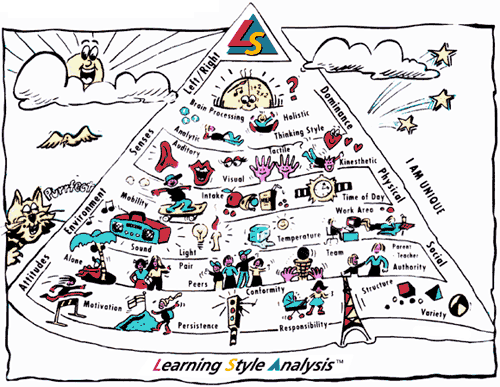
 If your child's learning style exibits preferences in the following LSA Pyramid Elements:
  • visual (external)
  • tactile
  • learning alone
  • stationary
then they are well suited to online learning. Try these sites:

Creative Maths Ideas - Traditional Games

 If your child's learning style exibits preferences in the following LSA Pyramid Elements:
  • tactile or kinesthetic
  • learning with a friend or friends
  • stationary
then they are well suited to learning through traditional games. Try:

Creative Maths Ideas - Outdoor Games

 If your child's learning style exibits preferences in the following LSA Pyramid Elements:
  • kinesthetic
  • learning with a friend or friends
  • mobility
then they are well suited to learning through outdoor activities. Try:

What learning style preferences does your child have?

 Find out today.

Thursday, March 10, 2011

Creativity and Learning Styles

What is creativity? Encyclopaedia Britannica defines it as: "Ability to produce something new through imaginative skill, whether a new solution to a problem, a new method or device, or a new artistic object or form. The term generally refers to a richness of ideas and originality of thinking.

Although psychological studies of highly creative people have shown that their learning styles lean heavily towards the holistic and disorganised, they've also noted that this lack or focus of a highly right-brained individual may stand in the way of success. No matter how original your idea, you have to implement and finish it in order to be truly creative. 

So what other Learning Style Pyramid elements do you need to be creative?

  • an Integrated Learning Style (holistic as well as analytic)
  • high persistence 
  • high responsibility
  • self-starter
  • self-directed
The Creative Learning CEO, Barbara Prashnig, was recently chosen to feature on photographer Allan Johnston's book on creative people.

Do you have what it takes to be creative? Check out your own Working Style now.


Thursday, February 17, 2011

Learning Styles - Sound, Temperature, Work Area

 
In last week's blog, we explored the effect light  has on the quality of homeschooling. Today, we will look at the remaining 3 elements of the LSA Pyramid that deal with the learning environment: sound, temperature, work area.

As parents, we are so used to making decisions for our children and so used to knowing what's best for them, we sometimes tend to forget to consult them about the choices we make. If the light in the learning room in too dim for us, we turn it up. If it's too hot, we open the window.

As teachers, however, we must remember the children's learning preferences come first. They are the ones who need to concentrate on new and difficult concepts. And the good news is that, just like with the lights, it's super easy to ensure all the children have the learning environment they need, even if they have to share the room.

Some ideas for children who need silence include:
  • ear plugs
  • ear phones (if they are also auditory learners)
  • indoor tents or caves made from old towels (if they also need dim lighting).
Ideas for learners who need an informal work area:
  • bean bags
  • cushions
  • sofas and armchairs
  • floor nests made from cardboard boxes and blankets.
Only one question left now. What is your child's Learning Style?

(Please note: Although these posts deal chiefly with homeschooling, the same principles apply in the conventional classroom.)


Thursday, February 10, 2011

Learning Styles and Home Schooling

Home schooling your child may well be one of the most difficult decisions you've ever made. It is also probably the most fun, rewarding... and, yes, difficult... tasks you've ever undertaken. Hopefully you live in an area where you have access to materials, learning tools, government support and other home-schooling families.

We, at Creative Learning, would like to support your endeavor by telling you about Learning Styles. Every one of your children, as we're sure you've noticed, learns in his or her unique way. Perhaps one of them likes to sit still in a brightly lit room and do the project on her own, while the other craves your constant input and prefers to memorize his times-tables while jumping up and down across the room.

Neither learning style is wrong, neither is better. They are both perfect for that specific child. However, as a parent, you may feel rather overwhelmed by the wealth of information included in your child's Learning Style Assessment.


So many elements to consider! Light, noise levels, time of day, visual input, tactile input, intake, perseverance... What is a parent to do?

Consider satisfying one element at a time. Let's take light as an example. Light is an important element of the LSA Pyramid and it can be a powerful irritant or a powerful sedative if used incorrectly.

If you discover that all three of your children concentrate well in bright light, for example, no problem! Make sure they always do their work in a well-lit room (daylight or bright bulbs, but never fluorescent - the constant flickering of fluorescent light is often stressful to the body on a subconscious level), or take them outside whenever the weather permits.

But let's say only one of your children likes bright light, while others do better in dimly lit rooms. Consider utilizing two rooms (one bright, one with diffused light), or create areas of bright as well as dimmer light in your home "classroom". On field trips, make sure the children who prefer darker learning environments wear sunglasses and/or front-facing peaked caps.

Once you've nailed the light aspect, move onto the next element in the pyramid. Tip: The environment elements will probably be the easiest to satisfy. Good luck!

If you're a home-schooling parent, please write to us at yvonne@clc.co.nz and the first 3 emails will win a free Learning Style Assessment.

Thursday, November 18, 2010

Learning Styles of Creative Minds

If you went back in time to, say, 30 years ago, and tried to tell people that:
  • you read newspapers and watch TV on your computer...
  • ... in fact, a few months ago you witness the rescue of 34 Chilean miners from 700m below the ground....
If you said:
  • you talk your friends and family across the oceans via a personal computer...
  • ... or via a phone you carry around in the street....
If you told them you watched the latest soccer World Cup live at the cinema in 3D, have an opinion on cloning and genetically modified foodstuffs, that night-time lenses can correct myopia and you can fit an entire library into your pocket...

... then people would call you very creative indeed. Creative with the truth, that is. And yet, this is precisely the weird and wonderful world we live in.

It takes a creative mind to imagine things that don't exist yet. What Learning Style would you expect such a creative person to have?

  • Integrated with a tendency towards holistic
  • Non-conforming
  • With a preference for change
  • Multi-sensory
  • High perseverance
How creative are you? Find out what your Learning Style is.

Picasso put it best: "Every child is an artist. The problem is how to remain an artist when you grow up."

Thursday, September 24, 2009

Watch that Maths!!!

Despite the teachers’ best efforts, some students still leave school without rudimentary numeracy skills. The message I keep hearing from parents is simple: watch the maths, because once your child falls behind on the basics, it’s a difficult journey to catch up again.

So how do you watch the maths?
  • Ask your child whether she likes her maths schoolwork and whether she thinks she’s good at it.
  • Ask your teacher whether your child is performing below, at, or above expectations for her age group.
  • Ask yourself what your child’s Learning Style is and what sort of games you can play with her at home to boost her confidence in her ability to “get” numbers. (Have a look here to find out.)

Depending on her learning preferences, you might:

  • Devise a colourful worksheet for your child to complete on a regular basis.
  • Play a board game that involves numeracy skills.
  • Organise a treasure hunt in the woods or on the beach (the clues are based on maths).
  • Make a flip chute or an electro board together (please contact us for more information on making learning tools).

Friday, May 29, 2009

Edward de Bono Hats and Learning Styles

Edward de Bono's Hats and Learning Styles


“The Six Thinking Hats” is a concept made famous by Edward de Bono. It’s a brainstorming technique used for investigating different perspectives towards a complex situation.


To put it simply, every participant in the brainstorming meeting is asked to put on a hat of a certain colour (literally or figuratively) and to think only about the implications of that hat. For example, if you’re wearing the White Hat (which stands for fact and information), you are only allowed to think and talk about the factual aspects of the problem you’re exploring. No emotions should enter your argument until you put on the Red Hat.


Edward de Bono also invented “The Six Action Shoes” to label business actions, as well as “The Six Value Medals” to appraise a project’s value.


Sounds like fun? Then you’re probably more of a global than sequential thinker, and you most likely enjoy change and variety.


Sounds a bit silly? If that’s the case, chances are good that your thinking processes are more analytic than holistic.


It all depends on your learning style, in other words, on the unique set of preferences and non-preferences that determines the way in which you concentrate and work at your very best.


Friday, January 16, 2009

Learning Styles Working for You

It’s 2009. No matter what your Learning Style (i.e., the way in which you absorb new and difficult information), the New Year is likely to bring about the two Rs: reflections and resolutions.

What was brilliant about the year 2008 for you?
What would you like more of in 2009?
How can you make it happen?

New Year Resolutions are great. The trouble is, sometimes even the best intentions don’t materialise. Why not? The reason is simple: it’s not enough to have direction and know where you’re going, you also need to know how to get there.

The bad news:
You may have heard of the book “7 habits of highly effective people”... well, what works for Steve Jobs, Bjorn Borg and Angelina Jolie won’t necessarily work for you, because your personal strengths will be different from theirs.

The good news:
Your Learning Style is the key to your own personal success.

· If your best thinking time is in the afternoon, you will not be doing yourself any favours by getting up early in the morning to do your business planning just because a few successful businessmen did just that. (Learning Style Element: Time of Day)

· If you are not big on lists, you will simply frustrate yourself trying to draw up a list of tasks every morning... knowing that you won’t stick to it anyway. (Learning Style Element: Information Processing)

· If you hate routine, regular work and sleep hours will make you bored and stressed. (Learning Style Element: Variety)

· If the idea of a reward.... (Learning Style Element: Motivation)

Did you know? As many as 49 Learning Style Elements make up your ideal working conditions. Our online tool, Learning Style Analysis (LSA) will help you determine those.

What is your Learning Style? How can you work according to your strengths? If you’re new to this site, click here to find out.

Friday, January 04, 2008

Learning Style Analysis - Spotlight on the MINI


Learning Style Analysis Junior MINI (or LSA MINI) is one of our products designed to assess the learning styles of children as young as 5 years of age.

Of course, in many countries children don’t learn to read until they are 6 or 7 (even later if they follow the Rudolf Steiner schooling system). So how can they do the LSA MINI questionnaire?

· The most obvious solution is for the parent to read it out to their child, or for the teacher to read it out to the class one question at a time, and taking a break after every three to five questions.
· An idea that might appeal to a child’s sense of wonder is for the computer to read the questionnaire out loud (using the free speech functionality of Windows XP or Vista).
· The parent may elect to answer the questionnaire themselves, putting themselves in their child’s shoes and using the knowledge they have of their child’s behaviour patters and interests.

The LSA MINI is also a great tool for older children whose concentration span is short, children who are learning-different, and people of all ages whose command of English is more suitable to shorter, simpler phrases (please check our website to find out whether we’ve already translated our products into your home language).

What happens once all the questions have been answered? The results of the questionnaire are processed algorithmically into three comprehensive reports (one for the student, one for the parent, one for the teacher), with summaries, graphs, pictures and detailed text, including information about the child’s predisposition towards computer technology, Internet safety, giftedness and underachieving. Take a look at this free online demo of LSA MINI.

What’s to come in 2008: all our LSA Parent reports will include important facts about learning styles and ADHD, learning styles and obesity, learning styles and smoking, learning styles and computer misdemeanours, learning styles and bullying. We are committed to a better learning future for all and we believe that early knowledge equals prevention.

Happy New Year, everybody!

Thursday, December 06, 2007

Your Learning Style and Learning Facts

What is more important: knowing facts or knowing how to find facts? What competencies and knowledge do our children need to be successful in the 21st century?

New Zealand’s government believes it has the answer in the form of a new curriculum, which “represents a shift away from focusing on knowing facts and figures to knowing also how to use knowledge effectively and apply it outside the classroom."

As an idealistic idea, it’s not a bad one. Why cram your brain with dates and formulae, which you can look up in the textbook or on the Internet? Why memorise concepts you don’t necessarily understand or know how to apply in your decision-making? Intelligence and school success should not be measured with, or equated to, the ability to memorise. Do away with learning by rote and replace it with teaching our children to think, right?

On the other hand, as somebody pointed out to me:

The shift away from learning facts is a bit of a worry. You wouldn't want to be left hanging in the middle of something (like surgery) to wait while the doctor quickly nipped into an Internet chat room to check how to stop your bleeding.

Whether you believe that it’s facts or the global overview that is the most important, is - naturally - dictated by your own unique Learning Style. If you like detailed information, you are most likely an analytic thinker. If, however, you value an overview above all else and consider particulars much less important, you are probably a holistic thinker.

Are you an analytic or a global thinker?
To find out your own or your child’s learning style,
have a look at this
free online demo.

Traditionally, schools have been geared towards analytic teaching and learning. New Zealand is trying to move away from that in favour of a less factual education system. If that means accommodating students whose information processing is non-sequential, while at the same time retaining the stimulation for sequentially-thinking students, that can only be a good thing.

Meanwhile, in the latest New Zealand education news, a furious debate broke out over a Level 3 Geography exam question (this equates to Year 13 and University Entrance can be gained by successfully completing NCEA Level 3). Five photographs (of images such as a park to a city's central business district) were shown, and students had to explain how each image could be viewed from a feminist perspective.

Some people consider it a wonderful question that allows students to think outside the square, others see it as an opinion-based non-factual question with a built-in advantage towards girls.

Have your say here. Leave a comment.

Friday, November 30, 2007

Learning Styles and Illiteracy

Globally, illiteracy is becoming one of the most prominent social pains of the 21st century. While in developing countries the problem is chiefly the lack of teachers, schools and teaching aids; the problem in the West is the overabundance of technology.

In a world where television, computers and cell phones reign supreme, books are taking a distant second place. Even SMS or email no longer resembles the written word, with shortcuts and phonics such as: “GTG PAW c u 2nite”.

Of course, struggling to read may have its roots in health issues such as vision problems or dyslexia.

More often than not, however, if a child has access to food, school and books - yet they have not acquired the ability to read, the problem may lie in their Learning Style.


Your child’s learning style dictates the way in which he or she understands and remembers new concepts. The learning style will also determine the way they learn to read.


If your child is not visual, for example, they will have no natural curiosity about books. If they need mobility for their learning, sitting still with a book is an unnatural thing for them to do. If they are not left-brained, the idea of starting the book at one end and continuing in a linear fashion will be foreign and uncomfortable.

You can help!


A tactile child will benefit greatly from being allowed to handle the book and trace the words with their fingers. An externally auditory child will prefer to read the words out loud. And you can keep a kinesthetic child’s interest by asking them to act out the plot of the book as you read it together.

Is your child tactile or kinesthetic?

Of course, as with any new learning, learning to read should take place in an environment that’s tailor-made for that specific child’s learning needs. The Learning style Analysis (LSA) report shows parents exactly how to turn the learning area at home into a successful one.

To find out your child’s learning style, have a look at this free online demo.

Thursday, November 01, 2007

Learning Styles and Learning Difficulties

  • Is your child bored at school?
  • Does homework become a daily battlefield?
  • Has the teacher ever mentioned that your child tends to be disruptive or undisciplined in class?
  • Are your child’s school results a poor reflection on the child’s intelligence and ability?
  • Has your child been diagnosed with ADD (ADHD) and you feel uncomfortable with that diagnosis?
  • Is your child’s reading level below expectation?
  • Is maths difficult?

    If you said ‘yes’ to any of the above points, your child may be experiencing a mismatch between her learning style and the way in which the school is teaching the curriculum.


    Your learning style dictates the way in which you understand and remember new concepts.

    Some of the factors that affect your child’s learning style, and therefore her learning success, include:
    * Her need for snacking during the learning process
    * The amount of real or artificial light in the room
    * The presence (or absence) of background noise in the room
    * Your child’s need for adult supervision or for learning in a group
    * Your child’s preferred sense or senses for information intake
    * … and many others.

    Ultimately, if your child’s learning style needs are not satisfied, she will experience learning difficulties. She may become unenthusiastic about learning new things, her self-confidence will plunge (she may start to believe she is ‘stupid’ or ‘slow’), her attitude may become rebellious or apathetic.

    To find out your child’s learning style, have a look at this free online demo.

Wednesday, October 24, 2007

Learning Styles and Your Career


Calling all Teenagers - Second-Timers Welcome!

Your career choice is one of the most important decisions you will have to make. Whether you are 16 or 46, you want to ensure that the job you’ll be doing for the next few years, 8 hours a day (at least), 5 days a week, is something that you can be passionate about and something that suits your own individual Learning Style or Working Style.


Every person has his or her unique learning style: some of us want visual props like photos and diagrams, others prefer listening to a taped lecture, others still will pace up and down the room in order to understand the new material better.


Similarly, we are also poles apart when it comes to the way we work: some of us tackle one task at a time and keep at it until it’s finished, while others prefer working on several things at the same time.


All these different preferences are called your Learning Style. And the thing is, they can be measured by applying a Learning Style Analysis (LSA).


It’s an online questionnaire and takes about 10 minutes to complete. As soon as you answer the questions, you receive a report with your own personal learning profile.


(You can find a free demo of learning style analysis here.)


So how do you use the information contained in the profile?


It’s really simple. The profile will make recommendations as to which careers may or may not be suitable for you. For example, if you can’t stand routine, your profile will say something like: “As you love change, and enjoy trying out new things, you hardly ever do the same thing the same way twice. It is important that you take into account your strong need for variety and your love of change when you consider future career planning.”


If you’re a talker who needs people interaction, the profile will guide you as follows: “For your future career planning it is very important to consider jobs which require good communication skills and a lot of people involvement.”


Sometimes the profile will list your preferences and let you decide what to do with the information, without suggesting a specific career path. Let’s imagine that your report says: “You have very strong analytical skills when it comes to problem solving or brain storming, and you always tend to use your rational, left-brain style first. When something is neither logical nor proceeding sequentially, you are not really interested.” The report will not state explicitly that you should seek careers that require strong analytic skills.


Your Learning Style Analysis report will not tell you that you should become a lawyer or try to dissuade you from following your dream to be an actor.


What the report will do, however, is list your strengths, your flexibilities and your non-preferences. That knowledge will be priceless when you’re considering your first (or your tenth) career.

(The link to the free learning style analysis demo again: click here.)

Thursday, October 18, 2007

Learning Styles and Traditional Schools


Today’s typical classroom may look totally different to the one in which our parents learnt: it may have tables that are big enough for ten children (as opposed to desks for one or two), the seats may be arranged in a circle (as opposed to in rows), and the blackboard may be white.

Some things, however, don’t change. Today’s pupils are still required to rely heavily on their eyes in order to take in information. The information may come from a textbook, a movie, an overhead projector or a demonstration of a science experiment - all of which are highly visual sources.

Similarly, when it comes to checking the child’s knowledge, it is usually done in a visual way: written homework, homework that involves reading or drawing, written tests.

This is why it’s crucial to know your child’s learning style. If they are highly visual, especially if combined with auditory, you can rest easy knowing that the learning material is presented to them in an optimal way. Of course, you still need to make sure that they are motivated and that other elements of their learning style are accommodated (sound, temperature, structure, the level of detail, social needs, and so on)... and you still have to check their eyes regularly to make sure they are up to the learning task.

If your child is not visual, however, they will probably struggle in a traditional school. While of course respecting their unique learning preferences, it’ll be a good idea to teach them some techniques that allow them to cope with the very visual world around us.

Some of the techniques include:
· Encourage your child to look at objects in greater detail: ask them to describe what they see at a first glance and what they see when they look again for a longer period of time.
· Play “spot the difference” puzzles and “Where is Wally”?
· Practice reading paragraphs of text together, then visualising it as a movie.
· Ask them to close their eyes and tell you what colour clothes you’re wearing.
· Do jigsaw puzzles together, particularly those that rely on utilising observation skills.
· Make a game out of watching people in the street, in the café, in the mall.
· At the supermarket, look at the shelves together and count the varieties of cereal, dried fruit and cheese.
· Organise treasure hunts (in the garden or the family room) that rely on observation skills alone. Let the “treasures” stick out or bulge out just a little, and encourage the children to find them with their eyes, not hands.

You can find a free demo of learning style analysis here.

Thursday, October 11, 2007

Learning Style + Teaching Style = Perfect Match


A learning style is the child’s preferred way of learning new things.
A teaching style is the teacher’s preferred way of imparting knowledge.

Have you ever wondered why it’s so important that the teacher’s teaching style should match the student’s learning style?

Just consider this recent (actual) news clip from Reuters:
“It's official: Your toddler is smarter than a chimp, at least at some things! In one social learning test, a researcher showed the children and apes how to pop open a plastic tube to get food or a toy contained inside. The children observed and imitated the solution. Chimpanzees and orangutans, however, tried to smash open the tube or yank out the contents with their teeth.”

Now compare the story above to the following (fictional) news clip that could have made headlines somewhere in a science-fiction universe:
“It's official: A chimp toddler is smarter than a human, at least at some things! In one social learning test, a researcher showed the subjects how to smash open a plastic tube containing food or a toy, or to yank out the tube’s contents with their teeth. The chimpanzee toddlers observed and imitated the solutions. The human subjects, however, tried to pop open the tube with their fingers.”

Makes you think, doesn’t it?

To read an article about learning styles, please click here.
To find out more about teaching styles, please have a look here.

A quick disclaimer: the above illustration is not meant to be derogatory to humans, apes, teachers or students in any way whatsoever.

Thursday, October 04, 2007

Learning Styles - How Your Child Learns Best

Learning Styles allow you to find out how your child learns best. When it comes to learning about Christopher Columbus, for example, she may find it easiest and most enjoyable to:
· Read a factual book on the subject.
· Read a novel on the subject, with a lot of the contents fictionalised.
· See the movie “1492”.
· Visit a museum exhibition about sea voyages.
· Make a model of the ship.
· Direct, write or star in a play about Columbus.

And that’s not all. When and where and with whom are also important choices when it comes to absorbing new information. Your child might like working alone or with friends, in the morning or the evening, in a quiet or busy spot.

To find out more, please visit Creative Learning and Prashnig Style Solutions and take the tour.

Did you know that...
.... your child's learning style affects more than just her grades?

· It also determines how she plays sport, forms friendships and communicates her emotions.
· It influences what she does for fun in her spare time and how safe she is on the Internet.
· It is a good indicator of whether - as a teenager - she will find it easy to say no to cigarettes, drugs and other dangerous activities.

Friday, September 28, 2007

Re-Train your Brain with Learning Styles

What if... you could influence your environment?
What if... you could think your way into being healthy or happy or successful?
What if... changing your mind could change your destiny?

That’s exactly what Dr Joe Dispenza (from the movie What The Bleep Do We Know!?) is promising in his books and seminars.

Dr Dispenza’s personal story reflects his doctrine. After a serious accident when he was twenty-three years old, he was left with a multiple-fractured vertebrae. he decided against surgery and literally thought his way to a full recovery in just 3 months. Amazed by the power of the human mind, he set out to learn more about the mind-body connection and the potential of the brain.

He discovered that the human brain is neuro-plastic: it can change its synaptic wiring by learning information and b recording experiences. This plasticity allows us to evolve our actions and modify our behaviour so that we are successful. The best way to retain this neuro-plasticity is to learn new things and make new memories, thus causing the brain to fire in new patterns and combinations. To change your mindset, you must make new neurons in your brain by repeating a thought or action over and over again until it becomes so effortless, it’s subliminal.

Now, because your environment is an extension of your mind, postulates Dr Dispenza, it stands to reason that if you change your mindset, you will change your environment.

A very simple manifestation of that is a smile. If you make yourself smile for no reason at all, you will feel happy (you’ve now changed your mindset). Moreover, you will make others smile back at you quite subconsciously, thus making them happier (now you’ve changed your environment). If you were to practice that for eight hours every day, what do you suppose the results would be?

According to Dr Dispenza, to change your fate you should:
1. Believe in a higher power.
2. Stop shifting the blame for your circumstances.
3. Visualise the outcome you desire daily (in other words, in your mind, you practice being the person you want to become).
4. Move out of the way and let the higher power arrange the result.

Of course, some people are better at change than others. Some have natural visualisation skills. Some may even be too goal-oriented to be able to relinquish control to the higher power.

Does your learning style stand in the way of change? To find out, please click here.

Quoted from "What the Bleep"...

"So, if we're consciously designing our destiny, if we're consciously, from a spiritual standpoint, throwing in the idea that our thoughts can affect our reality or affect our life, because reality equals life..., then, I have this little pact that I have when I create my day."

"I say to myself, I'm taking this time to create my day, and I'm infecting the Quantum Field. Now, if it is in fact [infecting my/the energy field], the Observer's watching me the whole time that I'm doing this, and there is a spiritual aspect to myself. Then, show me a sign today, that you paid attention to any one of these things that I created, and bring them in a way that I won't expect."

Friday, September 21, 2007

Learning Style - “Help, my child is impulsive!”

Does your child prefer to give a quick answer rather than a correct answer? Is her mind very quick? Does it constantly create new ideas?

If that’s the case, it’s possible that your child’s learning style is impulsive. She might have difficulties concentrating and staying focused on her schoolwork, she might get easily distracted from doing homework or paying attention to a task for a length of time.

For an impulsive child to thrive at school, she needs an understanding teacher who’s willing to accommodate her thinking style by allowing the child to answer in her preferred quick way and not discouraging her when she gets the answer wrong.

Fast-paced, short and challenging assignments suit an impulsive child’s thinking style best. A method that often works with impulsive children, is to ask them the question upfront and then tell them to find the answer in the textbook or in the classroom display cabinet (as opposed to telling them a lot of facts first and then asking questions about it). Asking one question at a time might also be a good way of keeping the child’s attention focused.

Another way may be to offer small rewards for every correct answer, thus motivating the child to become more flexible in their impulsive thinking style. Note: this will only work with externally motivated children (to find out more about your child’s motivation, please click here).

Either way, because impulsiveness is a biological trait, your child is not likely to change her thinking style very much as she grows older. To enhance her learning success in an environment that does not accept her impulsive style, she needs techniques for coping with being wrong some of the time, or with being labelled somebody who doesn’t think before they speak. You can help her by making her understand that this impulsiveness is simply part of her learning style, and not the person she is.

In any case, in today’s fast-paced society, it’s not always a bad thing to be impulsive. Sometimes a quick decision that’s not perfect may be better than a perfect decision that comes too late.

Did you know?
Impulsive decision-making is just one of 48 elements that make up your child’s learning style. To determine the other elements, analyse your child’s learning style here with our free demo.