Showing posts with label LSA. Show all posts

Thursday, November 06, 2014

What Teachers Can Learn From Students

In a recent study, a teacher took two days to replicate a student's life at school: she attended all the classes, played the sports and did the homework. Here's what she learnt:
  • Students spend a lot of time sitting, and it's more energy-draining than you can imagine. Before the first day was over, the teacher had a lot of empathy for children who fidget in their desks.
  • Students spend a lot of time having to listen. In many lessons, there's no opportunity to express your own views, you just have to assimilate those of the teacher. Even students who learn well by listening need a regular break to aid their concentration.
  • In some classes, students may feel belittled if they ask a question.
The problem doesn't end at school though. Sometimes it continues on the sports field, with the coach doing all the talking and reprimanding, as well as at home where homework awaits.

Depending on the child's Learning Style, they will be better or worse equipped to handle what's expected of them. Discover their optimal Learning Style today and learn what makes them tick.

Friday, October 24, 2014

Learning Styles Continue To Conquer Poland

(please scroll down for the Polish version)

Good morning. It's our privilege today to host in our virtual studio a Polish specialist in learning and teaching, an enthusiast of psychology, education, neuro-didactics and learning styles, as well as a mind map devotee: Joanna Prus. Earlier in October 2014, Joanna took part in the Conference Of Neuro-Didactics, attended by outstanding Polish and foreign lecturers in the field of neuroscience, neuro-didacticsand learning style analysis. We are honoured to be able to share her impressions from the conference.

Q: Joanna, please tell us about the general atmosphere of the conference.
A: It's amazing that something is finally beginning to vibrate slowly in the Polish rigid educational system. There are already quite a number of teachers searching for better and more effective teaching tools, people who have a passion and desire to grow, who are looking for new, more effective ways of working and strive to constantly improve them. I remember even just three years ago typing
"learning styles" into the Polish Google yielded disappointing results: one article written by a passionate teacher as well as my own website, where I described the LSA. In those days very few people were interested or knew anything about learning styles and the proof was the Google search results for the phrase "learning styles". This is why the atmosphere at the conference was so special - I finally felt that I didn't talk to a brick wall when discussing learning styles and proclaiming that all children are talented, they all like to learn, but they sometimes just have completely different learning preferences.

Q: And now, specifically, what did you think about Barbara's presentation?

A: Barbara is fantastic. I was impressed by her presentation - very substantive, yet interesting and engaging. Personally, I think the lecture is one of the most difficult forms of communication and you have to be a really good speaker to
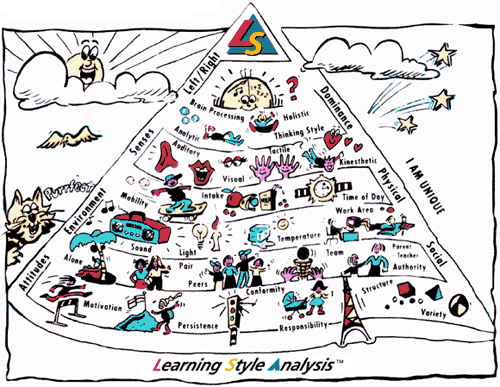
keep the audience's attention for an hour. Barbara, however, by the very way she presented, proved that learning styles are the key to success in education. In her lecture, there was something for auditory learners, visual learners, and kinesthetic learners - sound, music, text, images, movement and emotion. Something for the right and left hemispheres - the whole picture in the form of an LSA pyramid and an extremely logical analysis of the various elements. Barbara argued successfully how much can be achieved simply with the awareness of learning styles and understanding that students learn in different ways. 

Q: Other experts also attended - what interesting new concepts did they bring to the conference?
A: It was Dr. Marzena Żylińska, author of "Neurodydaktyka" and the cause of the whole positive vibe around this topic in Poland. Dr. Żylińska used a bitter joke to describe the mistaken direction of education in most schools today: "Sit down, Johnny, this is a school, no-one here is interested in what interests you." She tries to gather lessons learned from neuroscience and convince teachers, parents, and educators, that it is up to them to create an environment that determines what becomes of our children. Last year, she invited  Manfred Spitzer, a German neuroscientist, and this year she hosted the famous German professor of neurobiology and educator, Gerald Hüther, the author of the book "All children are gifted." Professor Hüther also starred in the acclaimed Erwin Wagenhofer movie "Alphabet".


What stood out for me in the professor's speech was that brain development is not genetically determined. The way in which our brain connects nerve cells does not depend on any genetic programming. Every child comes into the world with plenty of invaluable neural connections. Gerald Hüther illustrated it thus: like a sculptor carves a block of stone, so does a human by his/her activity and experience shape the neural structure of the brain, strengthening some connections and pruning the others. The "Mozart gene" or the "Einstein gene" doesn't exist. We parents, educators, teachers should not spoil the natural potential of our children, instead, we should create conditions for their development through love and acceptance. Entice, encourage, and inspire. The professor also highlighted the importance of cooperation between students, teachers, and parents. This was also strongly emphasized by Barbara Prashnig.
 
Q: Following the conference, what
will you do differently?
A: Good question. I wondered about this already before conference, as well as during it. Now I am convinced that the next step after the engagement of the teachers are the parents. We need to invite them to work with us to change schools for the better, to help children learn and to ensure their development in accordance with their predispositions. Parents want the best for their children, but often end up unknowingly ruining the natural potential of their children in the name of parental love. I see my role in helping parents, I would like them to notice their children's potential, recognize their learn preferences and discover their talents. Building a community, a kind of club for parents, students, and teachers - that's my dream.
 

Q. Wow. If anyone would like to try LSA in Polish, how can they contact you?
The easiest way to reach me is write to the address joannaprus@edu-you.pl, or contact us through our Facbook https://www.facebook.com/eduyou?ref=hl.

Thank you so much for the interview.


Wywiad po polsku


Dzień dobry. Dzisiaj gościmy w naszym wirtualnym studio polską specjalistkę od uczenia się i nauczania, pasjonatkę psychologii edukacji, neurodydaktyki oraz stylów uczenia się, wielbicielkę map myśli – Joannę Prus. W połowie października Joanna uczestniczyła w Kongresie Neurodydaktyki, w gronie znakomitych polskich i zagranicznych prelegentów z dziedziny neurobiologii, neurodydaktyki, analizy stylu uczenia. Jesteśmy zaszczyceni, że zechciała się z nami podzielić wrażeniami.

  1. Joasiu, powiedz nam ogólnie o atmosferze konferencji.
To niesamowite, że w Polsce wreszcie coś powoli zaczyna drgać w sztywnym systemie edukacji. Jest już całkiem spora grupa nauczycieli, którzy poszukują sposobów na lepsze i efektywniejsze nauczanie, ludzi, którzy mają pasję i chęci, by się rozwijać, którzy poszukują nowych, skuteczniejszych metod pracy oraz ciągle je doskonalą. Pamiętam, jak jeszcze zaledwie trzy lata temu wpisując w Google wyrażenie „style uczenia”, można było znaleźć w polskim Internecie zaledwie kilka wyników, z czego jeden artykuł napisany przez nauczycielkę pasjonatkę i moją stronę, na której opisałam LSA. Faktem jest, że rzadko kto się tym interesował i wiedział cokolwiek o stylach uczenia się. Dowodził tego również ówczesny raport Google, dotyczący wyników wyszukiwania frazy – „style uczenia”. Zatem atmosfera na Kongresie była szczególna, bo wreszcie poczułam, że nie „rzucam grochem o ścianę”, kiedy mówię o analizie stylu uczenia się, o tym, że wszystkie dzieci są utalentowane, że lubią się uczyć, tylko mają do tego czasem zupełnie różne predyspozycje. 

2.      A teraz specyficznie o wystąpieniu Barbary.


Barbara jest fantastyczna. Byłam pod wrażeniem jej wystąpienia – bardzo merytoryczne, a jednocześnie ciekawe i angażujące. Osobiście uważam, że wykład jest jedną z trudniejszych form przekazu i trzeba być naprawdę niezłym mówcą, aby przez godzinę utrzymać uwagę słuchaczy. Barbara jednak całą sobą udowodniła, że style uczenia się to klucz do sukcesu w edukacji. W jej wykładzie było coś dla słuchowców, wzrokowców, kinestetyków – dźwięk, muzyka, prezentacja, teksty, obrazy, ruch i emocje. Coś dla prawej i lewej półkuli – obraz całości w postaci piramidy LSA i niezwykle logiczna analiza poszczególnych elementów składających się na style uczenia się, w której jedno wynika z drugiego.
Barbara przekonała, jak wiele można zdziałać już samą świadomością i zrozumieniem tego, że  uczniowie uczą się w różny sposób.  
  1. Byli tam też inni specjaliści – co ciekawego wnieśli do sympozjum?
Była dr Marzena Żylińska, autorka książki „Neurodydaktyka” i sprawczyni całego pozytywnego zamieszania wokół tego tematu w Polsce. Dr Żylińska jednym gorzkim dowcipem opisuje niewłaściwy kierunek nauczania w większości dzisiejszych szkół - „Siadaj, Jasiu, tu jest szkoła, tu nikogo nie interesuje, co ciebie interesuje.” Stara się zebrać wnioski płynące z neuronauk, przekonuje nauczycieli, rodziców, pedagogów, że to my tworzymy środowisko, które decyduje o tym, czym zajmować się będą nasze dzieci. W zeszłym roku zaprosiła do Polski Manfreda Spitzera, niemieckiego neurobiologa, a w tym roku gościł równie znany niemiecki profesor neurobiologii i pedagog – Gerald Hüther, autor książki „Wszystkie dzieci są zdolne”. Profesor Hüther wystąpił również w głośnym filmie Erwina Wagenhofera „Alfabet”.

Dla mnie niezwykle interesująca w wystąpieniu profesora była informacja o tym, że rozwój mózgu nie jest uwarunkowany genetycznie. O tym, jak w naszym mózgu będą łączyły się komórki nerwowe, nie decyduje żaden program genetyczny. Każde dziecko przychodzi na świat z niedocenianą jeszcze dziś obfitością połączeń neuronalnych. Gerald Hüther tak to zobrazował – jak rzeźbiarz z kamiennego bloku wykuwa rzeźbę, tak człowiek poprzez swoją aktywność i doświadczenie kształtuje strukturę neuronalną mózgu – jedne połączenia wzmacnia a inne „przycina”. Nie ma – jak powiada profesor – „genu Mozarta” czy „genu Einsteina”. My rodzice, wychowawcy, nauczyciele nie możemy psuć naturalnego potencjału naszych dzieci, a stwarzać warunki do ich rozwoju poprzez miłość i akceptację. Zachęcać, dodawać odwagi i inspirować. Profesor również podkreślił ogromną rolę współpracy na linii uczeń – nauczyciel – rodzic, co również silnie podkreśla Barbara Prashnig.
  1. Co teraz, na skutek sympozjum, zamierzasz zacząć wdrażać w życie?
Dobre pytanie. Zastanawiałam się już nad tym tak przed kongresem jak i w jego trakcie. Teraz już jestem przekonana, że kolejnym krokiem po zaangażowaniu nauczycieli są rodzice. Aby zmienić szkołę na lepsze, ułatwić dzieciom naukę i zapewnić im rozwój zgodny z ich predyspozycjami, musimy zaprosić do współpracy również rodziców. Rodzice często chcą jak najlepiej dla swoich dzieci, ale często w imię właśnie rodzicielskiej miłości zupełnie nieświadomie psują naturalny potencjał swoich dzieci.  Widzę ważną rolę w pomaganiu rodzicom, chciałabym aby umieli tak spojrzeć na swoje dzieci, by zobaczyć drzemiący w nich potencjał, by potrafili rozpoznać ich predyspozycje do uczenia się i kształtujące się w nich talenty. Zbudowanie społeczności, czegoś w rodzaju klubu rodzica, ucznia i nauczyciela to moje marzenie.
  1. Jeśli ktoś chciałby spróbować LSA po polsku, jak może się z Tobą skontaktować?
Najprościej do mnie napisać na adres joannaprus@edu-you.pl można również się z nami kontaktować przez naszego Facbooka https://www.facebook.com/eduyou?ref=hl

Dziękujemy za wywiad.

Thursday, April 10, 2014

Free Group Profiles

All teachers know how important it is to get to know the learning styles prevalent in their class. But teachers don't always have enough time to read every single student's LSA profile in detail, what with 28-35 children in an average classroom. That's why here, at Creative Learning, we've updated our free group profiles to summarise every class's learning needs in one easy-to-understand report.

Say goodbye to unruly behaviour and blank looks. Find out what your class needs and enjoy a more stress-free learning environment. Simply purchase the LSA profiles for every student, let them complete the questionnaire online (they love this part), then run a group profile on the results. As easy as 1, 2, 3!

Start here.


Saturday, January 25, 2014

Many copies, none equal

There are many companies selling or even giving away some version of analysis based on Learning Styles.  Some of them are better than others. None are better than ours, at least in our opinion. Here’s why:

·         In addition to the usual visual-auditory-kinaesthetic analysis, we offer a comprehensive insight into your preferences in terms of working space, time of day, team work, attitude, and many others.

·         Our analysis is based on scientific research and confirmed through many decades of practical applications.

·         Our tool delivers your results in a detailed report with colourful graphs and thorough explanations.

·         The prices of our products are competitive.

We invite you to browse our website, www.clc.co.nz, and discover our Learning Styles for yourselves.


Thursday, July 18, 2013

9 Reasons To Do Your Child’s LSA Today

Something Cool to Do

Children love doing the LSA evaluation because there are no right or wrong answers and because the questions are all about them.

3 Versions of the Report

That’s between 10 and 20 pages of easy-to-understand fully illustrated analysis of your child’s learning potential and advice. Your child gets a copy aimed at them, you get a parent copy and you get a copy for the teacher that tells them how to treat your child in class.

Reach Their Potential

Is your child word-visual, picture-visual or internally visual? Externally or internally auditory? Tactile? Internally or externally kinesthetic? Or even all of the above? Find out and you will be directly responsible for their improved performance in 2006.

Is Your Child Gifted?

These may be the signs that your child is gifted:

  • can learn through several sensory modes
  • has a preference for evening or early morning
  • prefers to work alone or with true peers
  • won’t accept authority
  • is internally motivated
  • never gives up
  • dislikes rules
  • doesn’t need help in structuring their learning.
  

Motivation

Carrot, stick or neither? Some people call it bribery, others an incentive. But do you know whether your promise of a special treat will help your child’s work or hinder it? Read their Learning Style report to see whether your child is externally or internally motivated.
  

Goodbye Homework Horrors

The Learning Style report  will tell you how to turn your child’s study area into their favourite place in the house.

Accept Your Child’s Style

You know, when they surround themselves with piles of books, papers and dirty plates with half-eaten apples, it doesn’t mean that they’re trying to annoy you. It may simply mean that they process information in a holistic way. Do their LSA to find out.

Banish Eminem

The Learning Style report  will tell you whether your child will benefit from listening to music while doing homework. But the report will also tell you (and your child) what music is conducive to learning. More importantly, it’ll tell you which music NOT to listen to during study time.

Is Your Child Safe On The Internet?

If your child has a preference for visual and tactile stimulation, if he or she prefers learning alone and structuring their own work, if he or she has a non preference for kinesthetic and auditory activities (all of these available from the Learning Style report ), then the chances are high that they will enjoy spending a lot of time on the computer - possibly in chat rooms. Internet predators look for quiet children, often those who are underachievers socially or academically.

Thursday, June 06, 2013

Learning Styles and Stress Management


Think “childhood” and words such as “carefree”, “long summer days”, “doing nothing” or “fun” will instantly spring to mind. However, nothing can be further from the truth for the current generation of school-goers. In certain parts of the world, even preschoolers feel the pressure to achieve, and thus to secure a place in a reputable private education institution.

Some schools cite education and achievement as their top values. Others prefer to concentrate on learning through fun, treating every child as an individual with a unique learning style, and offering an all-rounded learning option that includes as much dancing as it does arithmetic.

The world out there is tough and competitive. Do you shelter your children and let them enjoy life as long as they can, or do you start grooming them for the rat race in kindergarten? That’s the choice that every parent has to make individually.

Meanwhile, if you think that your child is feeling stressed, their own learning style can give you a clue as to how to help them. Highly analytic children will want to retreat and solve the problem by themselves, while highly holistic children will want to discuss the issue with you. To find out how to deal with your child’s stress, please analyse their learning style.

Some ideas that might also appeal to your child include:

  1. Listening to music with a beat that is slower than their heart rate.
  2. Taking a walk together - a forest or a beach will particularly well.
  3. Essential oils such as lavender, chamomile, mandarin or rose have a calming effect - you can burn them in the room if you have a burner or dab them directly onto the wrist.
  4. A comforting healthy snack, like low-fat low-sugar apple pie or cocoa.
  5. Distraction: ask your child what the best thing was that she saw or did today.

Just as prevention is better than cure in the area of physical health, so it is with stress. If your child does not thrive on achievement, it’s best not to push them. To check, do their Learning Style Analysis.


Thursday, April 25, 2013

Should You Cyber-Spy On Your Kids?

Cyber spying is when you read the emails your children send and the emails they receive, when you check their browsing history and, in extreme cases, record every keystroke they type.

The case in favour of cyber-spying: "If your child refuses to talk to you, yet you sense something is going wrong in their life, it’s OK to read their emails and check what sites they’ve been visiting (making bombs, depression clinics, suicide pack pages), just as it’s OK to read their diary, their poems, their school essays, their blog, their Facebook updates. What they write can be a warning or a cry for help. If you read it in time, you can prevent disaster."

The case against: "School essays, Facebook and blogs are meant for public viewing. If your child writes something alarming in one of those, it’s because they want help, or perhaps just need to get your attention. Emails and texts, though, are private conversations, particularly for tween-agers and teens. The diary is like the child’s personal psychotherapist, and therefore strictly confidential."

Whichever option you choose, here are a few indicators that your child may spend too much time on the computer:
  • Their learning style shows a preference for tactile and visual learning.
  • Their learning style shows a non-preference for mobility when concentrating on something difficult.
  • They prefer studying alone.
What is your child's learning style? Find out today.


Friday, October 26, 2012

Learning Styles - The Cure For Underachievement

The younger children are, the more right-brain dominant they are; therefore they need more holistic, right-brain teaching methods because their analytical brain-processing skills are not yet developed and in many people (research estimates approximately two thirds of the Western population) holistic brain-processing remains the preferred thinking style throughout life. Most people can apply analytical thinking processes if they have to, but this makes learning harder and information storage much more difficult for them.

However, if a school system, which is based on analytical teaching methods, forces young people to do all their learning analytically (as this is the preferred teaching style, especially in academic subjects in most of our high schools) the result is that such a system sets up students for failure - especially those whose brain-processing is strongly holistic.

Another factor which contributes to the mismatch between teaching and learning styles is the well researched fact that teachers are strongly analytical in their approaches, more so in high schools than in primary schools (and even more in tertiary education) and cannot imagine that their specific subject area could be studied and presented holistically, in a more right-brain way. It is just not in their thinking! Such teachers also seem to have great difficulties in accepting that there is more than one way to learn anything, because due to their own sequential thinking processes, analytics believe 'their' way is the best and the only one.

And that false belief causes holistic students to fail, mainly in analytical subjects such as mathematics, science, economics, etc, which causes boredom and frustration, has a negative effect on their overall performance, and seems to be the main reason for behaviour and learning problems, which then lead to social problems among young adolescents.

Is your child analytic or holistic? Find out using our professional Learning Style Analysis instruments.

Friday, December 16, 2011

Stuck for that perfect Christmas gift?

This Christmas, give the gift that will last more than the lifespan of a battery. Give something that costs as much as a takeaway dinner. Give self-knowledge and peace of mind. Give the future.


Friday, October 28, 2011

E-Course: Last Chance to Register

Here, at Creative Learning, we are dedicated to the subject of learning. This means learning in all its forms and in every environment; from formal settings to home study to the workplace. Our speciality is HOW we learn, before WHAT we learn. If you'd like to learn more about Style Analysis (the HOW of learning), here's an opportunity for you: we are offering an online course during the first ten days of November 2011. Please email info@clc.co.nz to register. Teachers, parents, students - all welcome.

Friday, May 27, 2011

ADHD a made-up disease?

ADHD stands for Attention Deficit and Hyperactivity Disorder, howevermore and more doctors are speaking out against the ADHD diagnosis, claiming it has become a marketing strategy by pharmaceutical companies rather than a genuine medical disorder.


While it's true that some children may suffer from an unusually short attention span due to biological or environmental factors (see, for example, the superb article about food additives and ADHD), it is also true that many of ADHD symptoms are the same as the symptoms for a very common disease known as "being a child".


Most healthy children can't sit still. Most healthy children act before they think. Most healthy children are easily distracted. Some children display these "symptoms" more than others. It all has to do with their own unique learning style.


A learning style is the way in which a child understands and remembers new concepts. Have a look at the 49 elements that affect your child's learning. If your child needs mobility to understand new concepts, is impulsive or a dreamer, chances are, they will be misdiagnosed as having ADHD.

To determine your child’s learning style, let them complete their LSA Mini analysis today.

Thursday, February 17, 2011

Learning Styles - Sound, Temperature, Work Area

 
In last week's blog, we explored the effect light  has on the quality of homeschooling. Today, we will look at the remaining 3 elements of the LSA Pyramid that deal with the learning environment: sound, temperature, work area.

As parents, we are so used to making decisions for our children and so used to knowing what's best for them, we sometimes tend to forget to consult them about the choices we make. If the light in the learning room in too dim for us, we turn it up. If it's too hot, we open the window.

As teachers, however, we must remember the children's learning preferences come first. They are the ones who need to concentrate on new and difficult concepts. And the good news is that, just like with the lights, it's super easy to ensure all the children have the learning environment they need, even if they have to share the room.

Some ideas for children who need silence include:
  • ear plugs
  • ear phones (if they are also auditory learners)
  • indoor tents or caves made from old towels (if they also need dim lighting).
Ideas for learners who need an informal work area:
  • bean bags
  • cushions
  • sofas and armchairs
  • floor nests made from cardboard boxes and blankets.
Only one question left now. What is your child's Learning Style?

(Please note: Although these posts deal chiefly with homeschooling, the same principles apply in the conventional classroom.)


Thursday, February 10, 2011

Learning Styles and Home Schooling

Home schooling your child may well be one of the most difficult decisions you've ever made. It is also probably the most fun, rewarding... and, yes, difficult... tasks you've ever undertaken. Hopefully you live in an area where you have access to materials, learning tools, government support and other home-schooling families.

We, at Creative Learning, would like to support your endeavor by telling you about Learning Styles. Every one of your children, as we're sure you've noticed, learns in his or her unique way. Perhaps one of them likes to sit still in a brightly lit room and do the project on her own, while the other craves your constant input and prefers to memorize his times-tables while jumping up and down across the room.

Neither learning style is wrong, neither is better. They are both perfect for that specific child. However, as a parent, you may feel rather overwhelmed by the wealth of information included in your child's Learning Style Assessment.


So many elements to consider! Light, noise levels, time of day, visual input, tactile input, intake, perseverance... What is a parent to do?

Consider satisfying one element at a time. Let's take light as an example. Light is an important element of the LSA Pyramid and it can be a powerful irritant or a powerful sedative if used incorrectly.

If you discover that all three of your children concentrate well in bright light, for example, no problem! Make sure they always do their work in a well-lit room (daylight or bright bulbs, but never fluorescent - the constant flickering of fluorescent light is often stressful to the body on a subconscious level), or take them outside whenever the weather permits.

But let's say only one of your children likes bright light, while others do better in dimly lit rooms. Consider utilizing two rooms (one bright, one with diffused light), or create areas of bright as well as dimmer light in your home "classroom". On field trips, make sure the children who prefer darker learning environments wear sunglasses and/or front-facing peaked caps.

Once you've nailed the light aspect, move onto the next element in the pyramid. Tip: The environment elements will probably be the easiest to satisfy. Good luck!

If you're a home-schooling parent, please write to us at yvonne@clc.co.nz and the first 3 emails will win a free Learning Style Assessment.

Thursday, August 27, 2009

Learning Styles - the smart parents' choice for smart children


A Learning Style is the optimal way in which a child concentrates, learns new concepts and memorises information.

Learning Styles are more than Left-Brain / Right Brain

You will find many “tests” on the Internet, tests that promise to tell you whether your child’s left brain or right brain is dominant. That’s not a Learning Style, that’s just Information Processing.

Learning Styles are more than VAK

You will also find assessments that tell you whether your child is visual, auditory or kinesthetic. But will they make a distinction between visual as in watching (TV, other children) or visual as in reading (instructions, textbooks) or visual as in visualising the new material in their imagination? Will they check whether “kinesthetic” actually means external, internal or tactile?

Please see our LSA Pyramid for a complete list of the sensory modalities which may form your child’s learning preferences.

What You Can Do

Does your child think best in the morning or in the afternoon? Do they need a formal area in which to study? Will they learn quicker if they listen to soft learning music? Have a look here to find out.

Thursday, June 25, 2009

Chewing Gum and Learning Styles

Question: My daughter’s Learning Style indicates she has a strong preference for intake. I myself also noticed that her concentration improves when she’s allowed to chew or nibble on things. Unfortunately, teachers don’t allow chewing gum during ballet lessons or piano lessons, and gum is banned at school. What can I do?

Answer: The first step is to show the teachers your daughter’s Learning Style Results (see sample) and explain why chewing is such an important part of some children’s learning process. If they are not flexible on gum, perhaps they would allow a sports drink bottle in class. You can also experiment with chewable necklaces, ribbons or pens.


Question: Back up. What exactly is a Learning Style?

Answer: A Learning Style is the unique set of preferences and non-preferences that determines the way in which you concentrate best. In simple terms, it is a list of:

  • things that help you learn, and
  • things that make learning harder.

In the example above, a strong need to chew while concentrating on the new topic, was identified as 1 of the 49 elements that make up the girl’s Learning Style.

Question: 49? Really? What are they?


Answer: Amazing, isn’t it? There really are 49 things that affect the way you learn. Some of the elements that help or hinder your studies include:

  • the amount of light in the room
  • what time it is (earlier is not always better!)
  • what motivates you
  • whether you like learning in a group
  • how happy you are with lists and bullet points

For the complete picture, please see our LSA Pyramid.

Question: I’m ready to give learning styles a try. What do I do?

Answer: Welcome aboard! Have a look here.

Friday, January 16, 2009

Learning Styles Working for You

It’s 2009. No matter what your Learning Style (i.e., the way in which you absorb new and difficult information), the New Year is likely to bring about the two Rs: reflections and resolutions.

What was brilliant about the year 2008 for you?
What would you like more of in 2009?
How can you make it happen?

New Year Resolutions are great. The trouble is, sometimes even the best intentions don’t materialise. Why not? The reason is simple: it’s not enough to have direction and know where you’re going, you also need to know how to get there.

The bad news:
You may have heard of the book “7 habits of highly effective people”... well, what works for Steve Jobs, Bjorn Borg and Angelina Jolie won’t necessarily work for you, because your personal strengths will be different from theirs.

The good news:
Your Learning Style is the key to your own personal success.

· If your best thinking time is in the afternoon, you will not be doing yourself any favours by getting up early in the morning to do your business planning just because a few successful businessmen did just that. (Learning Style Element: Time of Day)

· If you are not big on lists, you will simply frustrate yourself trying to draw up a list of tasks every morning... knowing that you won’t stick to it anyway. (Learning Style Element: Information Processing)

· If you hate routine, regular work and sleep hours will make you bored and stressed. (Learning Style Element: Variety)

· If the idea of a reward.... (Learning Style Element: Motivation)

Did you know? As many as 49 Learning Style Elements make up your ideal working conditions. Our online tool, Learning Style Analysis (LSA) will help you determine those.

What is your Learning Style? How can you work according to your strengths? If you’re new to this site, click here to find out.