Friday, May 28, 2010

Solve your discipline issues with Learning Styles


Barbara Prashnig’s book, “Learning Styles in Action”, does more than help you implement learning styles: it actually helps you solve your stress and discipline issues.

The book is full of scenarios and diverse real-life situations. Among others, “Learning Styles in Action” shows you:

  • How learning styles can help underachieving or disruptive students
  • Multi-sensory teaching and learning in action
  • Ways to integrate learning styles and ICT (computer technology)
  • How to create a real learning styles classroom
  • The do’s and don’ts of using learning styles.
Each of the 24 chapters describes a particular aspect of style diversity and how to apply it in different situations – from nursery to university, from homework to exams, to sports coaching and sustaining change programmes in schools.

Many enlightened teachers are doing amazing work with young people. If you want to be one of them, read this book.

Thursday, May 20, 2010

Learning Styles and Reading Information

If you've read the previous post in the series (Learning Styles and Using Google), you will have seen that many students and school children are sadly incapable of getting information out of search engines. A number of factors may be at play here, and today we will look at one of them in more detail: the inability to read facts.

Thanks to the TV and the Xbox, many chilsren today aren't as good readers as their parents were at this age. However, we see children who are fluent readers and who love reading fiction still struggle with reading web pages and textbooks.

The same children who can't use Google are probably equally incapable of finding out facts in the encyclopaedia or "how to" books. It all comes down to the fact that a learning style is not a measure of how well you do something, but a preference for a way of presenting new and difficult concepts.

It would be a mistake to assume that just because your child reads a lot of books they can learn from non-fiction textbooks, just like a child who watches a lot of TV might not necessarily learn best from DVDs.

To determine your child's learning style, start here.

Thursday, May 13, 2010

Learning Styles and Using Google


There's a joke making its rounds on email lately, "Living without a Cell Phone". It's all about how hard our childhood's been compared to that of our children. One of the points it makes is the ease with which today's school children can access information online, whereas anybody over 30 still remembers having to go to the library and look it up in the card catalogue, request the book, wait two weeks, fetch the book....

It sounds like Generation Y and Z is living in Utopia and they "don't know how good they've got it". However, a recent study by Otago University (New Zealand) reveals a somewhat different picture. Although school children in developed countries today have easy access to the Internet and they know how to load up Google, what they don't know is how to squeeze information out of it.

Their failure to conduct online research (even when the topic was well-defined, such as, find out how the kiwi bird got its name) is attributed to a number of reasons:
  • mistyping
  • inability to phrase the search properly
  • inability to filter out relevant hits
  • incomprehension of what they're reading.
All valid theories, of course. Nevertheless, Creative Learning would like to add another hypothesis to the mix: that of the children's learning style.

To use a computer effectively, a child should have certain learning style strengths, such as visual (words), visual (external), tactile, working well alone. In addition, to perform a meaningful Google search, a child needs a balance of analytic and holistic processing skills, the ability to sit still and the ability to work in an unstructured way.

Can your child cope with finding relevant information online? To determine your child's learning style, start here.


Friday, May 07, 2010

Story Magic - Bring Stories to Life with Learning Styles

We all agree how important it is for the next generation to love books, right?

Absolutely!

But when it comes to books, it's not all about reading... not only about the skill of reading. It's also about the actual stories. Stories are a useful way to teach children our values (it pays to be noble and righteous, because good overcomes evil in the end), introduce the concept of "baddies" in a loving, secure environment, as well as inform us about the way things work (from making soup to what a hearing aid is).

All children love stories, so it makes sense to smuggle in new and difficult information to them using the medium of the written word...

... except, of course, not everybody's learning style is visual (words), in other words, not all children enjoy having to read the words themselves.

What is a parent to do?
  • If your child is auditory (internal), click here to listen to children who read stories to other children.
  • Children who are auditory external may prefer to read the stories out loud and to re-tell them to you in their own words.
  • If your child is visual (external), watch this site.
  • Kinesthetic children will enjoy acting out the stories as you read them out loud.
  • Tactile children may want to draw or make the characters from the story, participate in reading touch-and-feel books, or even make ordinary books into tactile books themselves.
To determine your child's learning style, start here.

Thursday, April 29, 2010

The Art of Communication

49 elements make up your personal learning style, and about half of them have a direct bearing on the way in which you communicate with others:

· Visual communication versus auditory communication

  • Whether you give and receive new information sequentially or holistically
  • Time of day (some people tend to think better first thing in the morning, others do not).

· Setting (formal or informal - they both mean different things to different people and can make them feel uneasy).

· Mobility (some people think better when literally on their feet).

· Light (the lighting in the room should vary according to the needs of the individuals. It really is a myth that brighter light is better. People who prefer dimmer lighting find bright fluorescent light stressful and bothersome.)

· Background noise (to some people, a silent environment is the only way to work, but others may feel energised by the friendly hum of a busy office or by quiet music.)

· Speed (is the person you’re speaking to somebody who likes to make quick decisions, or do they need time to reflect on what you’d said).

· Content (is humour going to be appreciated? Should you use a real-life example or an anecdote? Is a list a good idea? Bullet points? Graphs and pictures? Are you better off with a set of slides or one really good physical model of what you’re trying to convey?)

How do you communicate? Find out today.

Thursday, April 22, 2010

Practical, useful, encouraging!

(by a spokesperson from Ballarat Secondary College, excerpt)

If you were going to be asked to ‘learn something new and difficult’ how would you go about doing it? You might find that you need to talk with someone or find a quiet place with natural light and that a cup of tea would help. Others may find that breaking the task down to a checklist and then lying on the floor while listening to music may make the task more manageable.

At Ballarat Secondary College we are discovering that knowing a student’s learning style assists us in developing personalised learning strategies for the individual and the preferred learning styles of entire class cohorts. Undertaking Learning Styles Analysis, with both our staff and students, has opened up a greater understanding of how we learn. In the past we have worked with Bloom’s Taxonomy and Gardiner’s Multiple Intelligences amongst others, which was beneficial, but the Learning Styles Analysis takes this to another level, one that is far richer and holistic.

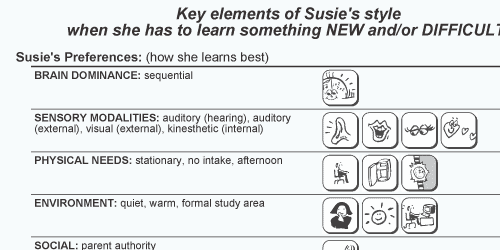
The LSA brings the complex interrelationship between biological, learned and environmental learning preferences into a simple diagram. In addition, it interweaves brain dominance, sensory modalities along with physical, environmental, social and attitudinal components of learning in such a way students as young as twelve through to staff can successfully interpret it. All agree that they have learnt more about themselves and others as learners.

(...) At Ballarat Secondary College we are so impressed with Keys to Success and Learning Styles Analysis we are embedding it into our College curriculum.


Thursday, April 15, 2010

Charlotte Reznick speaks about The Power of Your Child's Imagination


Is your child's Learning Style suited to the Tools of Imagination?

Q1. In your book, The Power of Your Child’s Imaginationyou share with us the importance of accessing a child’s imagination to help them handle everyday problems. Dr. Reznick, why is it important to access your child’s imagination to handle their problems?

Dr. CR: Parents come to me with all sorts of concerns. Like not sleeping at night, having all sorts of fears and worries, not doing well at school or sports, not being able to manage their anger and frustration, not getting along with their brothers and sisters, being devastated when their parents fight or divorce, having stress headaches and stomach-aches, and sometimes just feeling awful about themselves. Yet kids have many of the answers they need to solve their everyday problems right inside. With a little guidance to help them tap into their own imagination and develop their intuition, I’ve seen thousands of kids figure out what works for them. Like nine-year-old Alex who imagined a magical white dragon around his bed to keep him safe at night. Or six-year-old Sara who received a Gift of a crystal star from her Wizard to remember to love herself no matter what.

Basically, Moms and Dads are good at handling their kids’ problems, but sometimes we don’t always know which tool to apply when. This book assists you in choosing what’s best when. It’s as if it puts nine of my secret ingredients into your pantry and helps you choose what’s right for your child right now. There are Nine Imagination Tools that you can teach your child to use with most of the problems they face each day. The book teaches you what these tools are, and which ones work best for which problem. It gives scripts for the Nine Tools and guided journeys you can use immediately. You can mix and match the Tools to suit what works best for your child in each particular situation. There is also support for you as a Parent, on how to nurture yourself while raising your kids, and will lead to less stress for you, and more relaxed parenting.

Q2: You say that sleep issues are a major concern for kids today. How can parents use imagination to help their children fall asleep quickly and easily?

Dr. CR.: Parents ask me all the time about sleep problems. No matter how old a child is, trouble falling asleep is the most common complaint, followed by trouble staying asleep. 30 to 70 percent of kids have a sleep problem at some point. Let me tell you about Sophie. You might recognize some of her issues in your child. Eight-year-old Sophie was exhausted. She tossed and turned for hours. She was short-tempered all day from her lack of sleep. Her parents were exhausted and exasperated. When I met her, Sophie told me exactly what her problem was. She said, “I can’t turn off my brain. Stuff keeps spilling out.” She drew a picture of her life – dark, rainy, with no love. But, when I asked her if she could imagine what her life would be like when she could turn off her brain and sleep easily, she transformed that picture. She imagined a land of Love with the sun shining and flowers growing. She said her crabbiness would be gone and she’d feel really happy and proud of herself.

This simple spark of her imagination was the first step toward change. It’s important that she acknowledged where she was, and could imagine where she wanted to go. Then we took the steps to get there. The Imagination Tools that worked best for Sophie were… one, the “Balloon Breath,” breathing deeply into her tummy to calm herself. Second, imagining a “Special Place” to fall asleep. She loved to imagine falling asleep peacefully while floating on a fluffy white cloud or in her favorite vacation place. She was lucky enough to go Hawaii the year before and she loved swinging on the hammock in front of the room. And third, meeting a wise “Wizard” who gave her “Gifts.” Sophie imagined a Harry Potter type teenage wizard who dressed in a cool violet skirt and a hot pink blouse with a gold crown, who gave her magic berries that helped her body relax deeply and fall asleep. And her Wizard’s wise advice to her was, “If you believe you’re already sleeping, you’ll be asleep in a minute,” Of course that’s clearly coming from Sophie herself. Which is the point – you child has the wisdom and answers inside. All you have to do is choose which Nine Tools work best.

Dr. Charlotte Reznick has dedicated her life to helping children, adolescents, parents, and professionals. She is a nationally recognized child and educational Psychologist and Associate Clinical Professor of Psychology at UCLA. Upon earning her Ph.D. in Educational Psychology from the University of Southern California, she was honored with "Dissertation of the Year" for her work on the effects of parental divorce on adolescents.

The Power of Your Child’s Imagination is a heart-felt guide that shows parents and professionals how to empower children with easy, effective, and creative skills for surviving – and thriving – in our stressful world. It’s an indispensable guide that provides nine simple tools to help kids access their natural strengths and resources. There’s a mini-primer for each Tool—a sample script, troubleshooting tips, and real-life examples of how it is used. The Tools are adaptable to all ages (even adults can use them), and their benefits accumulate over time.

For more information, or to purchase a copy of The Power of Your Child's Imagination, please visit
http://www.imageryforkids.com/