Wednesday, September 26, 2012

The Power of Multiple Senses

Today's blog post is provided by our guest, Tanja Gardner. Tanja  has a BA in Psychology, Diplomas in Creative Writing and Business Communication, and a Certificate in Technical Communication.

The power of your senses

Our minds tend to form associations through our senses. You might link the smell of popcorn with going to the movies, the melody of a song with the way you felt when you last heard it, or the taste of a fresh tropical fruit with a holiday you took. Anything that engages one of your senses can become a "sensory cue" that your brain links with a mindstate, feeling or memory. The more often, and more exclusively you link a given cue with a particular mindstate, the stronger the association.


Why engage multiple senses?

We humans are usually creatures of more than a single sense: we can generally see, hear, touch, taste and smell. Granted, some of us can't use one of our senses, but most of us get input from more than one sense at a time.

That's important when you're trying to create associations, because there's a kind of synergy that comes from combining different sensory cues. The link will be stronger than if you only used a single sense. In fact, for most people, the more senses you can engage at once, the stronger the link.


Figuring out the right sensory elements for you

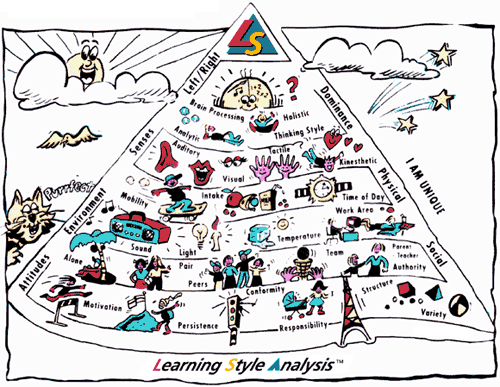
Even if they have access to all five senses, many people identify more strongly with one sense than another. Neuro Linguistic Programming (NLP) talks about "sensory modalities" and groups people according to the sense they use most to process information:
  • Auditory people tend to identify most strongly with sound, rhythm and melody.
  • Visual people respond to images, colours and shapes.
  • Kinaesthetic people think in terms of touch, feel, texture and temperature.
  • Olfactory people respond strongly to smell, and gustatory people to taste (although these two are very uncommon as predominant senses).
Actually, most people respond to more than one sense, but you’ll probably identify more strongly with one sense more than the others.


(Creative Learning: Tanja uses the power of the senses to build up personal writing rituals, however, they can also be used when working on any project, be it work, studying or a hobby. Have a look to see how the senses connect to your learning style).


Tanja Gardner is a professional copywriter, word weaver and story spinner at Crystal Clarity Copywriting Ltd.   She helps difference-makers like you write with concise, creative clarity that your readers intuitively “get”.  That means they understand EXACTLY what you offer – so you can make more of a difference in their lives. 
To connect with Tanja, say hello on Twitter or Facebook, or follow her blogOr, discover how to bust through writer’s block with her “Create Your Own Writing Ritual” e-course” – FREE when you sign up for her weekly writing tips.


Thursday, September 20, 2012

School Without Classrooms

A new-idea school has just opened in Stockholm. No classrooms. No grades. No grouping children by age. On the surface, the concept sounds brilliant: innovative furniture to boost creativity, the opportunity to work on projects in groups or to do one-person research.

As far as learning styles are concerned, the school is catering for a lot of the learning style elements: the children can sit on comfortable sofas, they can work in social setups of their choice, there are bright lights and dimmer corners. Students who like independent work, informal structures and variety, are definitely benefiting from this environment.

But what about children who like routine and sitting at a desk and lots of teacher-guided learning? They're probably better off at a conventional school.

Would your child thrive in a school with no classrooms, like Vittra Telefonplan below? Find out.

PS Stockholm is a city of innovation. Have a look at this iPad act.


Thursday, September 13, 2012

Prevent Teacher Shortage with Learning Styles

In most parts of the world, including New Zealand, figures show that the birth rate is increasing. This means that in 5 years' time - give or take - we will need more teachers to accommodate the new school entrants. Combined with the aging teacher population, statisticians predict a teacher shortage for as early as 2016.

The trouble is, teaching is often an under-appreciated profession. Apart from Finland, where teachers enjoy the status equivalent to that of USA medical doctors, many developed countries don't recognise the importance of having excellent teachers. No wonder, then, that many university graduates choose career paths other than teaching.

We at Creative Learning would like to help. We have tools to make teachers' jobs easier and as stress-free as teaching can get. Our new improved group profiles let the teacher know at a glance how to plan their lessons and where the hot spots of challenge may lie. Best of all, the group profiles are free: you can get as many as you like when you buy a school package that analyses the students' learning styles.

Thursday, September 06, 2012

Do Your Kids Listen?

Whether you're a parent or a teacher, there comes a point (on a very bad day) when you throw your arms upwards to the silent sky and demand: "Why won't they just listen?"

In case your question wasn't rhetorical, here are some possible explanations:
  • Because they're children. It's their job to not listen.
  • Because they think they know what you're going to say.
  • They listen, they just don't want to obey.
  • Their learning style has a non-preference in the listening department.
That last point needs a bit explaining. Some people, be it adults or children, are simply not good at absorbing information through their ears. They are the ones who prefer to learn by watching, reading about it or taking part in a real-life experience such as a laboratory experiment or a field trip.

If that's the case, you can still get your children to pay more attention when you're talking - you just have to make sure a few of their other learning style preferences are satisfied. Perhaps your child will listen better in a more informal environment or at a different time of day? Perhaps they'll respond better in a warmer room or if they're allowed to nibble on pieces of fruit?

What are your child's listening preferences? Find out here.

Wednesday, August 29, 2012

Learning Styles and E-Books

E-books or paper books? Could your personal preference have to do with your learning style?
If you think about it, e-books make sense: they save paper and shipping cost, you can store them mor eeasily, you can carry a thousand of them in your handbag.

Moreover, many e-readers come with an Integrated Dictionary, which allows you to look up words you’re not sure of. The Text To Speech function will read out the text for you, ultimately turning your e-book into an audio book. Colour displays are available on some e-readers. At the moment, you have a choice of bright colour with a computer-like screen (thus losing the like-paper look of e-paper display e-readers), or faded colours with an e-paper display that’s easy on the eyes.

So while the trend towards accepting e-books is continuing, you have to wonder why e-books have not taken over the book world completely. The answer lies in people's preferences, and those can be best illustrated using the framework of learning style elements.

If your learning style displays a strong preference for reading (as opposed to listening), the audio feature of the e-reader is not going to do anything for you. If your learning style indicates a preference for kinesthetic internal input, you may discover you're sentimental and don't want to part with paper books. Similarly, if your learning style has non-preference for change, switching from paper to electronic format is going to cause you stress.

Fortunately, paper books ar enot going anywhere for now.

Did you know?

Most e-readers currently available are made for adults. If your children read chapter books, those e-readers are great for them. Younger children, however, will benefit from bright colourful graphics, easy navigation, sturdiness and minimal weight of e-readers made especially for children, like VTech’s V.Reader. Its e-books are full of colour, animation, sounds and bubbly music.

Thursday, August 23, 2012

Three bad habits that may be good

1. Chewing


Does your child chew her collar, her nails or the pen when she’s concentrating? According to Barbara Prashnig, a world expert in education and the director of Auckland-based Creative Learning Systems, chewing may actually help your child understand the world better. Children’s learning ability is often enhanced by the action of chewing.


2. Wriggling around

Mobility is another important aspect of a child’s learning style. If your child wriggles when asked to sit still, or runs around in circles while you’re trying to talk to him, chances are, he simply needs to move around in order to listen better.

To find out if that’s the case, ask him what you said while he was moving around, seemingly not paying attention. If he can repeat it, it means that mobility is part of his learning process. Remember to talk to his teachers when he starts school and warn them that your child is not being naughty, on the contrary, he’s trying to listen when he wriggles.


3. Asking “why?”

If your child asks, “Why do I have to?”, it’s probably because she genuinely needs to know. Children whose brains work in a holistic fashion need to be given the overall picture before they can focus on the details.

Today it’s: “Why should I clean my room?” Tomorrow it may be: “Why is there no cure for cancer and why don't I try to find it?”


Your child’s learning style consists of 49 elements. Find out your child's unique strengths here.

Thursday, August 16, 2012

What does your classroom look like?

Do you still remember the squeak of chalk at school and blackboards that were black? Passing notes? Waiting for the bell to ring? Can you picture the bleak rows of desks, carved by generations of bored students into hearts and slogans? Can you feel the heat pulsating from the coal furnace? Ok, maybe not coal furnace....

What's changed since then? In first-world countries, blackboards have turned white and multimedia; classrooms have heat pumps and new desks. In developing countries, children sit on the floor and they don't have textbooks. But is that such a bad thing?

Not at all, according to Barbara Prashnig, an international expert in education and learning according to your strengths. Some children actually exhibit a learning style preference for learning in a more relaxed environment, away from the formality a desk and an upright posture brings. Similarly, lots of children don't well learn from books, preferring instead to listen to the teacher's stories and applying the lesson to real life examples.

What does your child prefer: floor or desk? Textbook, video, or field trip? Find out today.