Thursday, June 24, 2010

Use Creativity Correctly in Your Media Relations

(a guest post by Jonathan Bernstein)

Creative writers and thinkers can be some of the best – and some of the worst – media sources. Because we’re creative, we’re good at coming up with what journalists call “golden nuggets,” pithy sound bytes which make their stories read or sound better. For example, I’m fond of talking about the “Three C’s of Crisis Communications,” the notion that a good communicator needs to come across as Confident, Competent and Compassionate. Reporters eat that up. Ditto for another phrase I coined some time ago, “In the absence of communication, rumor and innuendo fill the gap.”

However, there is such a thing as being TOO creative, and getting caught up in hyperbole that turns a good interview into what sounds – to a reporter – like advertising copy or like someone trying to sound cute for cute’s sake, both being a real journalistic turn-off.

So, with that introduction, please enjoy this excerpt from Keeping the Wolves at Bay – Media Training:

Welcome to a new way of thinking about media relations. Even if you have given many ‘good news’ interviews in the past, you’re almost certain to say or do things you’ll regret if you have not been media trained when in a ‘high pressure’ media interview situation. Heck, you may say or do things you’ll regret even if you are media trained – but it’s less likely!

There are some other benefits to this process. Formal media training will:

· Help you develop and refine key messages, to see what really works under the stress of simulated interviews ( and good media trainers will make you forget it’s simulated).

· Optimize your chances of achieving balanced coverage. You’ll notice I say ‘optimize’ – there are no guarantees in this arena.

· Improves skills that transfer to many other types of public speaking – e.g., community presentations, testifying at hearings or in court, giving webinars, etc.

· Allows you to identify who’s an effective spokesperson in general, and who, specifically, may be better for different types of interviews. See Section 4: Media Logistics. And who, perhaps, should not be a spokesperson at all.

In the six years since I published the first edition of this manual, I have seen a dramatic difference in the results of my media training when trainees read the manual pre-training. I think it would have the same result no matter who conducted the training, so I encourage you to take the time to make that happen.

Media relations is, of course, only one component of crisis communications (CLS footnote: Working Style Analysis is another), one of many methods of getting messages to your stakeholders, both internal and external. In times of crisis it’s absolutely essential that your communicators be trained in all those methods. And that they practice their skills regularly, which is why this manual now includes, for the first time, a special section about how to practice media interview skills effectively without a trainer present.

(We invite you to join us for the Keeping the Wolves at Bay virtual tour. The schedule and more details can be found at http://bookpromotionservices.com/2010/04/28/keeping-wolves-bay-tour/. For more information and to get your copy, visit http://www.thecrisismanager.com/ or http://www.amazon.com/Keeping-Wolves-Bay-Media-Training/dp/1450582206)

Thursday, June 10, 2010

A Learning Style Profile of a Teenage Video Gamer

The Pros
  • Video games improve your hand-eye coordination.
  • They can teach you problem solving, quick thinking, logistics, mapping, spacial manipulation and many other skills.
  • Playing is more interactive than watching TV.
The Cons
  • Video games eat up the time that might otherwise be spent doing active stuff outdoors.
  • Even if you're playing in teams, gaming is not a social activity.
  • For certain personality types, violent games may lead to violent behaviour in real life.
  • It's an addictive pastime.
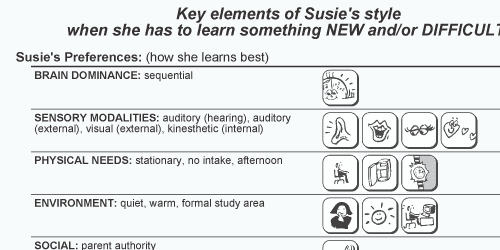
Of course, a teenager whose learning style is kinesthetic and social-groups is less likely to become addicted to gaming than a teenager who is a loner, concentrates best when sitting still, has a combination visual-tactile learning style with a high persistence component. To determine your teen's learning style, start here.

Thursday, June 03, 2010

Anger Management and Learning Styles

Anger and Irritability


Are you prone to numerous outbursts of anger or frequent bouts of irritability? Chances are, you are experiencing a working style mismatch.

Everybody has a unique Working Style a way in which you concentrate, make decisions and solve problems. If you are forced to work in a different way, one that is not inherently you, you will usually experience stress and frustration, which may result in your losing your cool in front of your boss or your loved ones.

The mismatches can be anywhere:
  • multitasking when you're a type of person who needs to concentrate on a single thread (In today’s electronic world, it’s not unusual to read emails while talking on the phone; and it’s virtually expected of you to handle several projects at the same time.)

  • details versus the big picture
  • communication style
  • type of lighting in the room
  • time of day
  • see more here.


Are you feeling stressed?

If you find it hard to concentrate at work or experience feelings of stress when entering your office, it could be that at least one of your biological needs is not satisfied. Ask yourself:

· Do I need to sit while working, or would I prefer to move about?

· Would sipping a glass of water or eating an apple while reading email help my concentration?

· Could I work more effectively earlier in the day or later at night?

· Do I need silence or background music when concentrating?

· Should my office light be bright or dim?

· Should my office be cool or warm?

· Does my desk feel right or would I rather work on the floor?

· Do I like working on my own, or do I miss being part of a team?

To answer these questions, do a Working Style Analysis (WSA) today.


Friday, May 28, 2010

Solve your discipline issues with Learning Styles


Barbara Prashnig’s book, “Learning Styles in Action”, does more than help you implement learning styles: it actually helps you solve your stress and discipline issues.

The book is full of scenarios and diverse real-life situations. Among others, “Learning Styles in Action” shows you:

  • How learning styles can help underachieving or disruptive students
  • Multi-sensory teaching and learning in action
  • Ways to integrate learning styles and ICT (computer technology)
  • How to create a real learning styles classroom
  • The do’s and don’ts of using learning styles.
Each of the 24 chapters describes a particular aspect of style diversity and how to apply it in different situations – from nursery to university, from homework to exams, to sports coaching and sustaining change programmes in schools.

Many enlightened teachers are doing amazing work with young people. If you want to be one of them, read this book.

Thursday, May 20, 2010

Learning Styles and Reading Information

If you've read the previous post in the series (Learning Styles and Using Google), you will have seen that many students and school children are sadly incapable of getting information out of search engines. A number of factors may be at play here, and today we will look at one of them in more detail: the inability to read facts.

Thanks to the TV and the Xbox, many chilsren today aren't as good readers as their parents were at this age. However, we see children who are fluent readers and who love reading fiction still struggle with reading web pages and textbooks.

The same children who can't use Google are probably equally incapable of finding out facts in the encyclopaedia or "how to" books. It all comes down to the fact that a learning style is not a measure of how well you do something, but a preference for a way of presenting new and difficult concepts.

It would be a mistake to assume that just because your child reads a lot of books they can learn from non-fiction textbooks, just like a child who watches a lot of TV might not necessarily learn best from DVDs.

To determine your child's learning style, start here.

Thursday, May 13, 2010

Learning Styles and Using Google


There's a joke making its rounds on email lately, "Living without a Cell Phone". It's all about how hard our childhood's been compared to that of our children. One of the points it makes is the ease with which today's school children can access information online, whereas anybody over 30 still remembers having to go to the library and look it up in the card catalogue, request the book, wait two weeks, fetch the book....

It sounds like Generation Y and Z is living in Utopia and they "don't know how good they've got it". However, a recent study by Otago University (New Zealand) reveals a somewhat different picture. Although school children in developed countries today have easy access to the Internet and they know how to load up Google, what they don't know is how to squeeze information out of it.

Their failure to conduct online research (even when the topic was well-defined, such as, find out how the kiwi bird got its name) is attributed to a number of reasons:
  • mistyping
  • inability to phrase the search properly
  • inability to filter out relevant hits
  • incomprehension of what they're reading.
All valid theories, of course. Nevertheless, Creative Learning would like to add another hypothesis to the mix: that of the children's learning style.

To use a computer effectively, a child should have certain learning style strengths, such as visual (words), visual (external), tactile, working well alone. In addition, to perform a meaningful Google search, a child needs a balance of analytic and holistic processing skills, the ability to sit still and the ability to work in an unstructured way.

Can your child cope with finding relevant information online? To determine your child's learning style, start here.


Friday, May 07, 2010

Story Magic - Bring Stories to Life with Learning Styles

We all agree how important it is for the next generation to love books, right?

Absolutely!

But when it comes to books, it's not all about reading... not only about the skill of reading. It's also about the actual stories. Stories are a useful way to teach children our values (it pays to be noble and righteous, because good overcomes evil in the end), introduce the concept of "baddies" in a loving, secure environment, as well as inform us about the way things work (from making soup to what a hearing aid is).

All children love stories, so it makes sense to smuggle in new and difficult information to them using the medium of the written word...

... except, of course, not everybody's learning style is visual (words), in other words, not all children enjoy having to read the words themselves.

What is a parent to do?
  • If your child is auditory (internal), click here to listen to children who read stories to other children.
  • Children who are auditory external may prefer to read the stories out loud and to re-tell them to you in their own words.
  • If your child is visual (external), watch this site.
  • Kinesthetic children will enjoy acting out the stories as you read them out loud.
  • Tactile children may want to draw or make the characters from the story, participate in reading touch-and-feel books, or even make ordinary books into tactile books themselves.
To determine your child's learning style, start here.