Showing posts with label children. Show all posts

Thursday, April 25, 2013

Should You Cyber-Spy On Your Kids?

Cyber spying is when you read the emails your children send and the emails they receive, when you check their browsing history and, in extreme cases, record every keystroke they type.

The case in favour of cyber-spying: "If your child refuses to talk to you, yet you sense something is going wrong in their life, it’s OK to read their emails and check what sites they’ve been visiting (making bombs, depression clinics, suicide pack pages), just as it’s OK to read their diary, their poems, their school essays, their blog, their Facebook updates. What they write can be a warning or a cry for help. If you read it in time, you can prevent disaster."

The case against: "School essays, Facebook and blogs are meant for public viewing. If your child writes something alarming in one of those, it’s because they want help, or perhaps just need to get your attention. Emails and texts, though, are private conversations, particularly for tween-agers and teens. The diary is like the child’s personal psychotherapist, and therefore strictly confidential."

Whichever option you choose, here are a few indicators that your child may spend too much time on the computer:
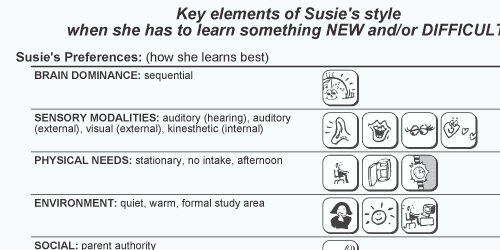
  • Their learning style shows a preference for tactile and visual learning.
  • Their learning style shows a non-preference for mobility when concentrating on something difficult.
  • They prefer studying alone.
What is your child's learning style? Find out today.


Friday, October 01, 2010

Learning Styles - Food, Glorious Food

What does your Learning Style have to do with food? A lot, according to international education expert, Barbara Prashnig.

Your Learning Style influences what you eat and when. It dictates how you shop and how you cook. As much as you may be reluctant to admit it, your Learning Style rules your life!

Take the learning style need for intake, for example. If you have a preference in this learning style element, you will want to snack whenever you're concentrating on something new or difficult. If you're kinesthetic, you will prefer soft-textured food. If you're tactile, you'll enjoy eating with your fingers.

But that's only the beginning. Analytic thinkers will stick to the shopping list when shopping and to the recipe while cooking. Holistic thinkers won't have a shopping list and will adapt the recipe to suit their mood and the contents of their pantry.

People whose learning style welcomes change will probably be more willing to try new and weird food, particularly if their other learning style preferences are satisfied. So if your child is a fussy eater, try to introduce new food in an environment catered to his or her particular learning style and see the difference!

Thursday, July 29, 2010

Toy Story 3 or Shrek 4?

Toy Story 3 or Shrek 4? Most reviewers seem to favour Toy Story. Which one do you prefer? The answer may lie in your learning style (which is not only the way you learn, but also the way you experience the world).

On the face of it, Toy Story 3 will appeal to anyone who:
  • likes to work / play alone
  • can work in a team
  • enjoys outdoor experiences and adventure.
Shrek 4 will appeal to anyone who:
  • likes to work / play alone
  • can work in a team
  • enjoys outdoor experiences and adventure.
But wait, there is one important difference. Toy Story 3 is all about accepting change, while Shrek 4 is about going back to the old and embracing routine.

Of course, you can be as analytic as you want. But ask a 5-year old which movie is better, and he'll tell you without hesitation: "Toy Story, because it didn't have all the kissing."

Thursday, May 13, 2010

Learning Styles and Using Google


There's a joke making its rounds on email lately, "Living without a Cell Phone". It's all about how hard our childhood's been compared to that of our children. One of the points it makes is the ease with which today's school children can access information online, whereas anybody over 30 still remembers having to go to the library and look it up in the card catalogue, request the book, wait two weeks, fetch the book....

It sounds like Generation Y and Z is living in Utopia and they "don't know how good they've got it". However, a recent study by Otago University (New Zealand) reveals a somewhat different picture. Although school children in developed countries today have easy access to the Internet and they know how to load up Google, what they don't know is how to squeeze information out of it.

Their failure to conduct online research (even when the topic was well-defined, such as, find out how the kiwi bird got its name) is attributed to a number of reasons:
  • mistyping
  • inability to phrase the search properly
  • inability to filter out relevant hits
  • incomprehension of what they're reading.
All valid theories, of course. Nevertheless, Creative Learning would like to add another hypothesis to the mix: that of the children's learning style.

To use a computer effectively, a child should have certain learning style strengths, such as visual (words), visual (external), tactile, working well alone. In addition, to perform a meaningful Google search, a child needs a balance of analytic and holistic processing skills, the ability to sit still and the ability to work in an unstructured way.

Can your child cope with finding relevant information online? To determine your child's learning style, start here.


Wednesday, February 03, 2010

Chewing Hair - A Matter of Learning Style


  • “Take that hair out of your mouth!”
  • “Stop biting your nails!”
  • “Have you eaten the other half of the bookmark?”
  • “Don’t suck your collar.”
  • “Don’t chew the pencil.”
  • “If you carry on biting your nails, you’ll get an infection.”

If this is a familiar mantra in your household, wait. Before you start painting your child’s fingers, pens and clothes with bitter substances, try to get to the root cause of the problem.

Every child has their own unique Learning Style, in other words, every child learns in a different way:

  • some need to feel good about the topic they’re learning,
  • some need to make a model of the new concept,
  • some need to work closely with a group of friends in order to understand best...
  • ... and some need to chew something while concentrating.

All in all, there are 49 Learning Style Elements that affect your child’s ability to concentrate on their school work. Please have a look at the LSA Pyramid to see what they are.

If your child tends to chew when reading or doing homework, give them sugar-free gum, a healthy snack, a water bottle or a wooden spoon to chew on. Less stress for you, more learning for them.

Incidentally, would your child enjoy playing a maths-based board game or baking a cake in order to learn their fractions? Find out here.

Thursday, October 15, 2009

Learning Styles and 3D Animation Movies

Next time you see a movie or read a novel, try to guess what learning style elements the main characters exhibit. Of course, it’s impossible to know for sure unless the characters answer the LSA questionnaire (even experts get it wrong without the tool), but it’s great fun guessing!

Here is a Learning Style Analysis of the main characters in the latest 3d animation family movie called “Up”.

(Plot summary, compliments of www.imdb.com:

A young Carl Fredrickson meets a young adventure spirited girl named Ellie. They both dream of going to a Lost Land in South America. 70 years later, Ellie has died. Carl remembers the promise he made to her. Then, when he inadvertently hits a construction worker, he is forced to go to a retirement home. But before they can take him, he and his house fly away. However he has a stowaway aboard. An 8 year old boy named Russell, whose trying to get an assisting the elderly badge. Together, they embark in an adventure, where they encounter talking dogs, an evil villain and a rare bird named Kevin.)

Ellie’s Learning Style Elements:

  • Auditory (talking)
  • Kinesthetic (external)
  • Kinesthetic (internal)
  • Visual (external)
  • Visual (internal)
  • Tactile

Carl’s Learning Style Elements:

  • High Perseverence
  • Fluctuating Responsibility
  • Non-conforming

Russell’s Learning Style Elements:

  • Auditory (talking)
  • High Responsibility
  • Group-oriented

Evil Villain’s Learning Style Elements:

  • Works alone (don’t they all?)
  • Externally Motivated

For more Learning Style Elements, please see the LSA Pyramid.

To check your child’s or your own unique learning preferences, click here.

Thursday, August 27, 2009

Learning Styles - the smart parents' choice for smart children


A Learning Style is the optimal way in which a child concentrates, learns new concepts and memorises information.

Learning Styles are more than Left-Brain / Right Brain

You will find many “tests” on the Internet, tests that promise to tell you whether your child’s left brain or right brain is dominant. That’s not a Learning Style, that’s just Information Processing.

Learning Styles are more than VAK

You will also find assessments that tell you whether your child is visual, auditory or kinesthetic. But will they make a distinction between visual as in watching (TV, other children) or visual as in reading (instructions, textbooks) or visual as in visualising the new material in their imagination? Will they check whether “kinesthetic” actually means external, internal or tactile?

Please see our LSA Pyramid for a complete list of the sensory modalities which may form your child’s learning preferences.

What You Can Do

Does your child think best in the morning or in the afternoon? Do they need a formal area in which to study? Will they learn quicker if they listen to soft learning music? Have a look here to find out.

Thursday, January 22, 2009

Learning Styles teach you to Cook with Your Children


Cooking with your children is a good idea because:
· it’s fun
· it’s quality time spent with your little one
· kneading dough develops finger strength necessary for writing
· separating egg yolks from egg whites helps improve fine motor skills
· preparing food is a great way to explore the world around you with all your senses. (Talk about taste with your children: caster sugar and salt look similar, but do they taste the same? Smell the with vanilla essence and then the vinegar, then taste them both.)

Of course, as with everything else, when cooking with your child, you should take their Learning Style into account.


Tactile children will want to touch the dough, run their fingers through the pancake batter and poke them into the softening butter. Let them. It’s their way.

Analytic children will enjoy following the recipe. Even if they are too young to read, they will easily follow step-by-step instructions on tape or in picture form. They will also enjoy measuring everything. Weighing and measuring cake ingredients is a fun way to learn the basics of maths: is a teaspoon more than a tablespoon? It looks larger, now let’s check. A teaspoon is 5 ml, while a tablespoon is 12.5 ml. What is more, 5 or 12.5? Which looks more, 100g of sugar or 100g of flour? Which one weighs more?

Holistic children, on the other hand, might not want the recipe at all. They will prefer to experiment: “if I mash strawberries, add flour and two eggs then cook it all, what will happen, Mommy?”

Determine your child's Learning Style and make magic happen in your kitchen next time you cook with your children.