Showing posts with label homework. Show all posts

Saturday, November 09, 2013

Homework and Your Child’s Learning Style

If your child is auditory - they like to listen and talk - try one of the following homework hints:


  • Make a learning tape together with your child. Let her explain the new topic into the tape recorder.
  • Discuss the lesson together.
  • Encourage your child to compose and record a song, a poem or a radio play about the topic (e.g., World War II, global warming, flower pollination, Mexico).

If your child is visual - they like to read and look at images - try one of the following homework hints:

  • Create a mind-map, illustration, cartoon, poster, slide show, costume, historical time line, illustrated report.  
  • Watch a DVD about the topic (“The King and I” about Thailand, “Little Einsteins”).
 If your child is tactile - they like to handle objects in order to learn - try one of the following homework hints:
  • Make use of question-answer jig-saw puzzles), electro- boards (a bulb lights up for every correct answer), flip chutes, etc.  
  • Encourage your child to make their own memory aids: sculptures of molecules or board games depicting new topics.

If your child is kinesthetic - they learn best through physical experiences - try one of the following homework hints:


  • Bake a cake together to teach conversion from grams to kilograms.
  • Pantomime or act out a history lesson.
  • Play a board game to discover new facts.
  • Take a field trip to the zoo, a court house, a factory.
  • Put on a puppet show together.

Thursday, July 18, 2013

9 Reasons To Do Your Child’s LSA Today

Something Cool to Do

Children love doing the LSA evaluation because there are no right or wrong answers and because the questions are all about them.

3 Versions of the Report

That’s between 10 and 20 pages of easy-to-understand fully illustrated analysis of your child’s learning potential and advice. Your child gets a copy aimed at them, you get a parent copy and you get a copy for the teacher that tells them how to treat your child in class.

Reach Their Potential

Is your child word-visual, picture-visual or internally visual? Externally or internally auditory? Tactile? Internally or externally kinesthetic? Or even all of the above? Find out and you will be directly responsible for their improved performance in 2006.

Is Your Child Gifted?

These may be the signs that your child is gifted:

  • can learn through several sensory modes
  • has a preference for evening or early morning
  • prefers to work alone or with true peers
  • won’t accept authority
  • is internally motivated
  • never gives up
  • dislikes rules
  • doesn’t need help in structuring their learning.
  

Motivation

Carrot, stick or neither? Some people call it bribery, others an incentive. But do you know whether your promise of a special treat will help your child’s work or hinder it? Read their Learning Style report to see whether your child is externally or internally motivated.
  

Goodbye Homework Horrors

The Learning Style report  will tell you how to turn your child’s study area into their favourite place in the house.

Accept Your Child’s Style

You know, when they surround themselves with piles of books, papers and dirty plates with half-eaten apples, it doesn’t mean that they’re trying to annoy you. It may simply mean that they process information in a holistic way. Do their LSA to find out.

Banish Eminem

The Learning Style report  will tell you whether your child will benefit from listening to music while doing homework. But the report will also tell you (and your child) what music is conducive to learning. More importantly, it’ll tell you which music NOT to listen to during study time.

Is Your Child Safe On The Internet?

If your child has a preference for visual and tactile stimulation, if he or she prefers learning alone and structuring their own work, if he or she has a non preference for kinesthetic and auditory activities (all of these available from the Learning Style report ), then the chances are high that they will enjoy spending a lot of time on the computer - possibly in chat rooms. Internet predators look for quiet children, often those who are underachievers socially or academically.

Thursday, April 19, 2012

Déjà Vu - Homework and Grandchildren

When your children left home, you thought you’d seen the last of Pythagoras and his right-angled triangles. You thought wrong.

Remember the Bruce Willis line from DIE HARD 2: “How can the same @#$% happen to the same guy twice?” If you feel like quoting it every afternoon, you’re not alone. Today’s financial reality means more and more grandparents provide after-school care to their grandchildren.

Fortunately, this time round, you can be smarter about fighting in the homework war zone.

We are all unique. We have our own way of doing things. And that includes doing homework.


Research confirms that every child has his or her learning style: that is, the way in which they best learn and memorise new things. “Children can learn virtually anything if allowed to do it through their own personal strengths,” says Barbara Prashnig, an international education expert. “We all learn through our ears, eyes, hands and body. But some children learn through their hands a lot better than through their eyes. And that means that they need to construct a hydrogen molecule out of sticks rather than just stare at a diagram of one.”

Your grandchild has unique needs and non-preferences when it comes to the way they learn and do homework. There is no such thing as a difficult learner - only a learner who hasn’t realised how to learn according to their learning style.

Find out how your grandchild learns best.

Thursday, March 08, 2012

Learning Styles and Homework

Research confirms that every child has his or her learning style: that is, the way in which they best learn and memorise new things. “Children can learn virtually anything if allowed to do it through their own personal strengths,” says Barbara Prashnig, an international education expert. “We all learn through our ears, eyes, hands and body. But some children learn through their hands a lot better than through their eyes. And that means that they need to construct a hydrogen molecule out of sticks rather than just stare at a diagram of one.”

 
Your child has unique needs and non-preferences when it comes to the way they learn and do homework. There is no such thing as a difficult learner - only a learner who hasn’t realised how to learn according to their learning style.

Here are a few examples of doing homework creatively based on your child’s unique learning style:
  • Auditory - the child likes to interact verbally: Make a learning tape together with your child. Let her explain the new topic into the tape recorder.
  • Tactile - the child has a strong need to use hands when concentrating or listening: Encourage your child to make their own memory aids: sculptures of molecules or board games depicting new topics.
  • Holistic - the child needs to understand the whole idea before they can details: Convert the homework concepts to analogies and stories from the child’s own experience.
For more ideas, please consult the LSA Interpretation Manual.


Thursday, February 23, 2012

Learning Styles and the Times Tables

Even though the world we live in has a calculator built into every phone and iPod, our children are still expected to memorise the times tables. Depending on your child's learning style, they may accept the idea, or they may rebel against the task's inherent boredom.

Paradoxically, the problem deepens for those students who are good at maths. Because they know that 8x7 is the same as 8+8+8+8+8+8+8, they don't want to memorise the answer. Instead, they want to work it out every time, because it's more interesting. 16+16+16+8, this is the same as 32+24, so the answer is 56. Much more fun for an analytic brain to do the calculation than to learn by rote. The problem comes when the teacher needs an instant answer.

So, if memorise they must, what's the best way? Depending whether your child is visual, tactile, auditory or kinesthetic, here are some ideas on how to drill the times tables:
  • Put up a poster with the times tables on the inside of the toilet door.
  • When you're driving or cooking with your child, ask them five to seven times-table lines, like 3x3 and 7x6.
  • Let the child use cuisenaire rods to illustrate the answer. 
  • Write the question on the child's back and let them write the answer on yours.
  • Create a colourful worksheet to fill in.
  • Put the question in context: Anna's chocolate box has 4 rows of chocolates and each row holds 5 chocolates. How many chocolates are in the box?
  • Make up a song: Six times four is twenty-four. Or look for a ready song, for example,
To multiply by ten


you take the number then


Add a zero to it


And that’s the end. (http://www.songsforteaching.com/)

If you use the wrong approach for your child's learning style, you might put him off maths for a long time. Check their learning style today.

Thursday, February 09, 2012

Parents and Learning Styles


Study after study, scientific research has made it clear that parental involvement affects their children's education. "Parents who actively participate in their children's learning at home help them become successful learners.  They enable children to reach their potential not only in school, but also in life." (Henderson & Berla, 1994). 
It's natural, as well as beneficial, for parents to want to help with homework, or to explain lessons the child didn't understand at school. However, as a parent, you have to be aware of your child's learning style before you help them. If you're not, you might even be working in ways that impede your child’s learning. Children find it hard to understand what parents are trying to explain if the information is not presented in the way they learn best, i.e., through their learning style preferences.
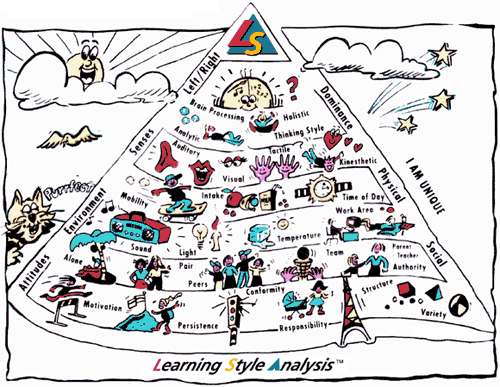
Learning-Style consists of six layers of learning-style elements: information processing, input through senses, social interaction, physical needs, environmental preferences, and attitudes.
Some children work best alone, others prefer to work with an authority figure or in groups of friends. Some children prefer visual aids while others like learning with their hands.
Your children can become outstanding in their schoolwork just as they do in other aspects of their lives. However, sometimes they need your guidance. When you recognise their individual learning styles, you will become better equipped to make learning a rewarding experience for your child. Find out how.


Thursday, February 02, 2012

Your Learning Style and School Writing Assignments

How often has your teacher told you to plan your writing assignment? It may have been a Pie Chart tool, or a List tool, or a fancy Head-And-Legs tool, but whatever it's called, whatever its shape, its purpose is clear: a story plan.

The trouble is, some people don't get inspiration from story plans. If your Learning Style is Holistic, you're not a planner. Asking you to plan your story before you put pen to paper (or fingers on keyboard) is as productive as asking you to squeeze a piece of coal in your fist until you get a diamond.

"Start at the beginning", is another favourite bit of writing advice. All very good for people whose Learning Style is Analytic. Analytic information processors like starting at the beginning and progressing step by detailed step to the logical conclusion.
Are you a Holistic or an Analytic writer? Find out here.

Thursday, September 22, 2011

Homework + Learning Styles = The Creative Way

The Question of Creativity

Is homework in your household creative? Creativity is the ability to produce something new, to generate unique ideas and solutions. The process of creating should be a fun energizing activity. Is homework in your household fun and energising?

Learning Styles
It should be. It can be. With the help of learning styles.


Kinesthetic - the child learns better through own physical experiences:


·        Bake a cake together to teach conversion from grams to kilograms.
·        Pantomime or act out a history lesson.
·        Play a board game to discover new facts.
·        Take a field trip to the zoo, a court house, a factory.

Tactile - the child has a strong need to use hands when learning:
·        Make use of question-answer jig-saw puzzles), electro- boards (a bulb lights up for every correct answer), flip chutes, etc.
·        Encourage your child to make their own memory aids: sculptures of molecules or board games depicting new topics.

Visual - the child remembers and understands best through watching:
·        Create a mind-map, illustration, cartoon, poster, slide show, costume, historical time line, illustrated report.
·         Watch a DVD about the topic (“The King and I” about Thailand, “Little Einsteins”).

Auditory - the child likes to interact verbally:
·        Make a learning tape together with your child. Let her explain the new topic into the tape recorder.
·        Discuss the lesson together.
·        Encourage your child to compose and record a song, a poem or a radio play about the topic (e.g., World War II, global warming, flower pollination, Mexico).
What is your child's learning style? Find out.
 

Thursday, March 31, 2011

Creative Kids - Story Writing

Learning Style To Blame

Your child's learning style will determine whether they enjoy creative writing. If they find it difficult to write about topics such as "If I had a magic potion" or "My first dragon", they may have a non-preference in holistic information processing as well as a non-preference in high persistence.

Feed the Well

You can help your child exercise their imagination by reading them a lot of story books, thinking up beginning of stories and asking the child what happens next, showing them how a real-life experience such as a trip to the fun park could be used in a work of fiction ("The princess went on the Spine Inverter Ride and BOOM she lost her crown. Oh no, she cried, I can't go back to the palace without it. Nobody will recognise me!"), or throwing random words into a hat and pulling them out to create a story line.

Assess and Assist

Sometimes, though, your child's imagination will simply go on strike. There isn't much you can do, except make sure that the child is as comfortable as they can be in their working area while they're writing their homework story.

A comfortable working area, one that's optimal for your child's creative muse, is different for different people. Some children will need bright light, others a healthy snack to nibble on. Some will want to be on their bed, others at their desk.

Assess your child's Learning Style to see what helps them concentrate. If you satisfy all their environment and physical learning needs, you'll make it easier for them to handle a homework task that's outside their comfort zone.

Thursday, February 10, 2011

Learning Styles and Home Schooling

Home schooling your child may well be one of the most difficult decisions you've ever made. It is also probably the most fun, rewarding... and, yes, difficult... tasks you've ever undertaken. Hopefully you live in an area where you have access to materials, learning tools, government support and other home-schooling families.

We, at Creative Learning, would like to support your endeavor by telling you about Learning Styles. Every one of your children, as we're sure you've noticed, learns in his or her unique way. Perhaps one of them likes to sit still in a brightly lit room and do the project on her own, while the other craves your constant input and prefers to memorize his times-tables while jumping up and down across the room.

Neither learning style is wrong, neither is better. They are both perfect for that specific child. However, as a parent, you may feel rather overwhelmed by the wealth of information included in your child's Learning Style Assessment.


So many elements to consider! Light, noise levels, time of day, visual input, tactile input, intake, perseverance... What is a parent to do?

Consider satisfying one element at a time. Let's take light as an example. Light is an important element of the LSA Pyramid and it can be a powerful irritant or a powerful sedative if used incorrectly.

If you discover that all three of your children concentrate well in bright light, for example, no problem! Make sure they always do their work in a well-lit room (daylight or bright bulbs, but never fluorescent - the constant flickering of fluorescent light is often stressful to the body on a subconscious level), or take them outside whenever the weather permits.

But let's say only one of your children likes bright light, while others do better in dimly lit rooms. Consider utilizing two rooms (one bright, one with diffused light), or create areas of bright as well as dimmer light in your home "classroom". On field trips, make sure the children who prefer darker learning environments wear sunglasses and/or front-facing peaked caps.

Once you've nailed the light aspect, move onto the next element in the pyramid. Tip: The environment elements will probably be the easiest to satisfy. Good luck!

If you're a home-schooling parent, please write to us at yvonne@clc.co.nz and the first 3 emails will win a free Learning Style Assessment.

Wednesday, February 03, 2010

Chewing Hair - A Matter of Learning Style


  • “Take that hair out of your mouth!”
  • “Stop biting your nails!”
  • “Have you eaten the other half of the bookmark?”
  • “Don’t suck your collar.”
  • “Don’t chew the pencil.”
  • “If you carry on biting your nails, you’ll get an infection.”

If this is a familiar mantra in your household, wait. Before you start painting your child’s fingers, pens and clothes with bitter substances, try to get to the root cause of the problem.

Every child has their own unique Learning Style, in other words, every child learns in a different way:

  • some need to feel good about the topic they’re learning,
  • some need to make a model of the new concept,
  • some need to work closely with a group of friends in order to understand best...
  • ... and some need to chew something while concentrating.

All in all, there are 49 Learning Style Elements that affect your child’s ability to concentrate on their school work. Please have a look at the LSA Pyramid to see what they are.

If your child tends to chew when reading or doing homework, give them sugar-free gum, a healthy snack, a water bottle or a wooden spoon to chew on. Less stress for you, more learning for them.

Incidentally, would your child enjoy playing a maths-based board game or baking a cake in order to learn their fractions? Find out here.

Thursday, April 23, 2009

5 Common Learning Mistakes - and how your Learning Style can help


  1. Studying the way your best friend does


You visit your best friend and you see that she has colour-coded folders for every school subject, where she keeps self-created mind-maps and highlighted texts from the textbooks. You think it’s a terrific idea and you buy your own set of folders... only it’s soooo boring to keep them up to date!


If that’s the case, chances are that your Learning Style is not analytic, and it may not be visual (click here to see what that means). You need to discover your own Learning Style and find out how you study best. Here’s how to do it.


  1. Doing homework the way your teacher says


·        Sit up straight at a desk.

·        Have a bright desktop lamp.

·        Make sure the room is quiet.


These are good suggestions, but only for people with preference for a silent, light-filled, formal environment. What does your Learning Style need in order to learn best? Find out.


  1. Leaving learning till last


Some people do well in tests even if they only study the night before or early on the morning of the test. When you try, however, you are too tired to concentrate.


That’s probably because your Learning Style doesn’t allow you to function well under pressure, plus you’re probably not a night owl or a lark. Discover what your Learning Style strengths are.


  1. Regular revision


All learners benefit from regular revision, but some people do not benefit from keeping to the same routine when revising. Does your Learning Style prefer variety or sameness? New ways or old ways? A predictable time slot? We can help.


  1. Study aids


Having study aids that are inappropriate for your Learning Style is even worse than having no study aids at all. If you are not tactile, tactile instruments will frustrate you. If you’re not auditory, learning tapes will bore you? What do you personally need?


Thursday, March 19, 2009

The Second Secret of Learning Styles - Why Your Desk Matters

The Second Secret of Learning Styles - Why Your Desk Matters


The Second Secret

As we’ve already learnt, the secret of Learning Styles extends beyond the visual / auditory / kinaesthetic manner in which you like to learn. While the LSA tool offered by us on this website does explore sensory modalities at length, we also look at many other elements that determine learning and working success. 


My Desk and I

·        Do you like working at a desk or would you prefer sitting somewhere less informal and more comfortable if given the choice?

·        Do you like putting your papers in folders and filing cabinets or have them stacked all over your room?

·        Do you want your desk (or equivalent) to be right by the window?

·        Are you happy in an office with no window?

·        Would you prefer to learn a new skill in a room that’s too cold or too hot?

·        How about the room itself: how quiet is too quiet for you?


“But wait, there’s more...”

Q: So is Creative Learning’s LSA tool VAK plus the desk?

A: No way! We consider 49 elements to determine your or your child’s unique Learning Style.


How can you be better at your job? How can your child do better at school? Find out.

Thursday, March 05, 2009

The Secret of Stress-Free Homework with Learning Styles

You can't do it? We're here to help!


Would You Buy Your Homework Online?

It’s not a joke! The French are doing it already: for just a few EURO their kids can download answers to their maths homework problems. "It is shocking. It defeats the purpose of education,” said a secondary school teacher in Paris. 


Of Course You Wouldn’t

The point of maths homework (and indeed, of most homework) is that you learn by repetition. The human brain evolved to notice patterns, and we are biologically programmed to derive enormous intellectual satisfaction from recognising the rules that govern a certain type of problem. For example:

·        210+30=240

·        310+30=340

·        410+30=440

·        510+30=540

·        ... oh, you mean when you add 30, you just change the middle column? COOL!!!


Homework In Style

Creative Learning instruments for assessing Learning Styles identify 48 elements that you need to consider when doing homework:

  • light
  • temperature
  • time of day
  • need for variety
  • need for a formal setup
  • need for parental supervision
  • etc.


What is a parent to do?


The Secret

The secret is our unique Learning Style Analysis. Let your child fill in our easy online questionnaire to access the full report of their learning needs and things that make learning harder for them.


Friday, August 22, 2008

Homework, homework, homework

“Responsibility for Homework: Children's Ideas about Self-Regulation” is a fascinating study into children’s attitudes towards self-motivation and homework. Pamela M. Warton’s research confirms what Learning Styles have known all along: some children are more responsible about doing their homework than others.

In Learning Styles, we look at the following elements of the Learning Style Pyramid to determine the child’s attitude to homework:
· internal versus external motivation (also known as self-starter versus awards-driven)
· responsibility
· persistence
· conformity
· teacher authority (the child’s need to please the teacher)
· parental authority (the child’s need to please the parent).

What Pamela M. Warton discovered, however, was an age-related shift in ideas: from others-regulated in 7-year-old students to self- regulated in 11-year-old students, irrespective of the students’ gender. This confirms that learning style elements such as motivation, responsibility, persistence, conformity and attitude to authority are learnt rather than biological, and that they can change over time.

Do you know your child’s learning style preferences for motivation, responsibility, persistence, conformity and authority? Click here to find out.

Of course, Learning Styles also give you the blueprint for your child’s optimal learning environment and helps you set up the homework area, taking the following needs into consideration:
· the amount of light
· temperature
· background noise
· furniture
· study groups
· structure
· routine
· and others.

What is your child’s optimal study environment? The answer is just a few clicks away.

Thursday, March 20, 2008

Learning Styles and Homework Myths

(To analyse your child’s learning style, have a look at this free online demo.)


Myth 1: Don't agree to having the TV or music playing while your child is doing his or her homework. It's nothing but distracting and teaches a habit that will be hard to break.

Truth 1: Research shows that many students think and remember best when studying with background music. Furthermore, 20% of an elementary population in a research study scored significantly higher when reading in a noisy environment.


Myth 2: Use folders, small boxes, manila folders or other types of stationery for storing school work, both past and present. This will teach a life long habit that makes achieving set goals so much easier.

Truth 2: Yes, being organised is a wonderful habit to have. However, a child whose information processing is global, will feel distressed or even threatened by a neat work area. Such children draw comfort from a less tidy and less structured homework environment and will find it impossible to function at an organised desk. And, speaking of desks....


Myth 3: Children learn best when sitting upright at a desk.

Truth 3: Sitting upright on a firm chair puts most of your weight on a very small part of your body. Many children (and adults) find it distracting to maintain such a body position for any length of time. Speaking from a learning style point of view, many learners need to sit in a less formal environment (floor, bed, sofa) in order to concentrate better, or concentrate at all. Which leads us to sitting....


Myth 4: Students who do not sit still are not ready to learn.
Truth 4: Many students need mobility when they learn because of their learning style requirements. An American study revealed that half of one school’s seven grade students needed extensive mobility while learning. When they were allowed to move from one instructional area to another while learning new information, they achieved statistically better than when they had to remain seated. Most students who are actively involved are likely to learn more, pay closer attention, and achieve higher test marks.


Myth 5: Students learn best in well-lit areas and damage their eyes when they read and work in low light.

Truth 5: Research shows that many students perform significantly better in low light environments, because bright light makes them restless, fidgety and hyperactive. Low light calms these youngsters down and helps them relax and think clearly. The younger children are, the less light they seem to need! They only need that amount of light for reading in which they feel comfortable, but their need for light seems to increase every five years.

(Does your child need bright light to do her homework? Find out here.)

Thursday, October 18, 2007

Learning Styles and Traditional Schools


Today’s typical classroom may look totally different to the one in which our parents learnt: it may have tables that are big enough for ten children (as opposed to desks for one or two), the seats may be arranged in a circle (as opposed to in rows), and the blackboard may be white.

Some things, however, don’t change. Today’s pupils are still required to rely heavily on their eyes in order to take in information. The information may come from a textbook, a movie, an overhead projector or a demonstration of a science experiment - all of which are highly visual sources.

Similarly, when it comes to checking the child’s knowledge, it is usually done in a visual way: written homework, homework that involves reading or drawing, written tests.

This is why it’s crucial to know your child’s learning style. If they are highly visual, especially if combined with auditory, you can rest easy knowing that the learning material is presented to them in an optimal way. Of course, you still need to make sure that they are motivated and that other elements of their learning style are accommodated (sound, temperature, structure, the level of detail, social needs, and so on)... and you still have to check their eyes regularly to make sure they are up to the learning task.

If your child is not visual, however, they will probably struggle in a traditional school. While of course respecting their unique learning preferences, it’ll be a good idea to teach them some techniques that allow them to cope with the very visual world around us.

Some of the techniques include:
· Encourage your child to look at objects in greater detail: ask them to describe what they see at a first glance and what they see when they look again for a longer period of time.
· Play “spot the difference” puzzles and “Where is Wally”?
· Practice reading paragraphs of text together, then visualising it as a movie.
· Ask them to close their eyes and tell you what colour clothes you’re wearing.
· Do jigsaw puzzles together, particularly those that rely on utilising observation skills.
· Make a game out of watching people in the street, in the café, in the mall.
· At the supermarket, look at the shelves together and count the varieties of cereal, dried fruit and cheese.
· Organise treasure hunts (in the garden or the family room) that rely on observation skills alone. Let the “treasures” stick out or bulge out just a little, and encourage the children to find them with their eyes, not hands.

You can find a free demo of learning style analysis here.

Friday, September 21, 2007

Learning Style - “Help, my child is impulsive!”

Does your child prefer to give a quick answer rather than a correct answer? Is her mind very quick? Does it constantly create new ideas?

If that’s the case, it’s possible that your child’s learning style is impulsive. She might have difficulties concentrating and staying focused on her schoolwork, she might get easily distracted from doing homework or paying attention to a task for a length of time.

For an impulsive child to thrive at school, she needs an understanding teacher who’s willing to accommodate her thinking style by allowing the child to answer in her preferred quick way and not discouraging her when she gets the answer wrong.

Fast-paced, short and challenging assignments suit an impulsive child’s thinking style best. A method that often works with impulsive children, is to ask them the question upfront and then tell them to find the answer in the textbook or in the classroom display cabinet (as opposed to telling them a lot of facts first and then asking questions about it). Asking one question at a time might also be a good way of keeping the child’s attention focused.

Another way may be to offer small rewards for every correct answer, thus motivating the child to become more flexible in their impulsive thinking style. Note: this will only work with externally motivated children (to find out more about your child’s motivation, please click here).

Either way, because impulsiveness is a biological trait, your child is not likely to change her thinking style very much as she grows older. To enhance her learning success in an environment that does not accept her impulsive style, she needs techniques for coping with being wrong some of the time, or with being labelled somebody who doesn’t think before they speak. You can help her by making her understand that this impulsiveness is simply part of her learning style, and not the person she is.

In any case, in today’s fast-paced society, it’s not always a bad thing to be impulsive. Sometimes a quick decision that’s not perfect may be better than a perfect decision that comes too late.

Did you know?
Impulsive decision-making is just one of 48 elements that make up your child’s learning style. To determine the other elements, analyse your child’s learning style here with our free demo.

Saturday, August 18, 2007

Learning Style Homework Tips

Learning Style Homework Tips

Homework can be a tricky area for parents. How do you prevent it from turning into a battlefield? Learning styles, in particular the learning style of your child, holds many of the answers.

Children, especially holistic children, need to know why they have to do homework. What’s the benefit of doing something at home that you’ve just done in class? How does homework fit into the general scheme of their education? Explain to your children that homework is important to reinforce skills that have been taught at school. It also gives teachers a chance to monitor the students’ progress. If the children allow it, homework can also be a great way to learn to work independently!
Analytic children, on the other hand, probably aren’t as interested in the big picture. If they refuse to do homework, it’s probably because the task at hand seems too big and they have trouble breaking it into manageable details. Help them organise the work into step-by-step portions and sub-tasks. Create a list of all the things that have to be done that day and let the child tick them off as they go along.
If you’re not sure whether your child is holistic or analytic, please take the quick test by clicking on this link: http://www.creativelearningcentre.com/products/learning-style-analysis/.

Bear in mind that you need to set up an appropriate environment and atmosphere for doing homework. Setting aside a specific place to do homework is a good idea (please see the tips on how to create an optimal study environment), but again, for some children this may be a quiet corner, while for others it could be the family room with the music on and papers strewn everywhere. Also, children who thrive on variety (see their LSA results) might like the study area moved or redecorated several times a month.

Some children like to have parents involved in their school life and in their homework. This doesn’t mean that parents do the work that their children are supposed to do - showing interest in what your child is learning at present and what their assignment involves may be enough. Your child might like you to give them a quick test at the end to see that they’ve understood the work. Other children, however, may have a different learning style, one that is conducive to working without parental supervision.

Setting a specific time for doing homework works well if you can tailor it to your children’s “time of day” preference based on their LSA results, but you have to be realistic about what you have available: if your child’s preference is for early morning learning, this will usually clash with the school’s timetable during the week, and you might not want to pile every weekend morning with homework!

If your child has a strong preference for morning learning, and a strong non-preference for afternoon and evening learning, you might have to discuss this with the teacher. Show them the child’s LSA report and ask how you can work together to combat the homework blues.

To check your children’s LSA results, here is that link again: http://www.creativelearningcentre.com/products/learning-style-analysis.

Thursday, March 22, 2007

Homework the right way

Step Press: Centre for Public Education in Alexandria, VA claims that homework overload does not raise student achievement. Their spokesman sys: "Information from international assessments shows little relationship between the amount of homework students do and test scores. Students in Japan and Finland, for example, are assigned less homework but still outperform U.S. students on tests."

And we agree, to an extent. It is true that students don’t need hours of homework for homework’s sake - that would simply take up their time and raise their frustration levels. What they do need instead, is a smart way of doing homework in such a way that it is fun, productive and time-efficient, a way which allows them to learn.

If you want a practical strategy to improve your child’s success at school, use the long proven Learning Style Analysis from Prashnig Style Solutions, www.pss-styles.com. Find out how to create a home study area conducive to doing homework the right way. Discover whether the teachers know how best to access your child’s potential. Confirm that your child is safe when doing homework on the Internet.

www.pss-styles.com - doing homework the right way.