We use Learning Styles every day of our lives, whether we're aware of it or not. The way we think, the way we read, the way we treat our partners... it's all encoded in our Learning Styles. Do you want to see yours?
WWW.CREATIVELEARNINGCENTRE.COM
Thursday, September 13, 2012
Prevent Teacher Shortage with Learning Styles
The trouble is, teaching is often an under-appreciated profession. Apart from Finland, where teachers enjoy the status equivalent to that of USA medical doctors, many developed countries don't recognise the importance of having excellent teachers. No wonder, then, that many university graduates choose career paths other than teaching.
We at Creative Learning would like to help. We have tools to make teachers' jobs easier and as stress-free as teaching can get. Our new improved group profiles let the teacher know at a glance how to plan their lessons and where the hot spots of challenge may lie. Best of all, the group profiles are free: you can get as many as you like when you buy a school package that analyses the students' learning styles.
Thursday, June 21, 2012
Discipline Issues and Learning Styles
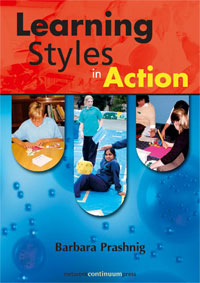
The book is full of scenarios and diverse real-life situations. Among others, “Learning Styles in Action” shows you:
· How learning styles can help underachieving or disruptive students
· Multi-sensory teaching and learning in action
· Ways to integrate learning styles and ICT (computer technology)
· How to create a real learning styles classroom
· The do’s and don’ts of using learning styles.
It’s a sad fact that, despite the many enlightened teachers who are doing amazing work with young people, there are still too many educators and particularly administrators and decision makers who believe learning should not be fun, it isn’t play and it can’t be made to look like play; it’s hard, hard work that cannot be made interesting. With such beliefs it is no wonder that too many students fail in education systems that do not cater for diverse learning needs.
If you want to make sure that your school is not one of those education systems, read this book. You will be amazed, astounded even, how little effort can translate into positive results.
Click here to buy the book.
Thursday, January 27, 2011
Learning Styles Succeed In A New Zealand School
Learning Styles, as defined by Creative Learning, go beyond brain hemispheres and visual-auditory-kinesthetic students. Sometimes all it takes is changing ONE ENVIRONMENT element to create a world of difference.
In the example below, the key element was the students' need for HIGH MOBILITY.
Please watch this exciting video about how a failing school can turn around to become an educational success story with the help of Barbara Prashnig and Learning Styles.
What ONE ELEMENT can you change in your school? We are here to advise you.
Thursday, July 23, 2009
Teaching Style Analysis and Group Profile of Learning Styles
· Why is it that the same group of students will behave perfectly with one teacher but act up in front of another one?
· Why are some classes notorious as “the bad” ones?
· What can the school do?
The answer
That’s 3 questions, but the answers all in Creative Learning’s special Style Assessment tools.
It’s all a matter of latches and mismatches. Every student has a unique Learning Style. Every class has a unique Group Profile. Every teacher has his or her unique Teaching Style. It’s as simple as that.
But how does it work, exactly?
While some principals use the teachers’ teaching style (TSA) to decide which teacher should teach which group of kids, most schools don’t have that luxury.
What they do instead is compare the TSA to the group profile of the class once they've assigned teachers and classes, in order to determine what the potential areas of tension might be. For example:
· The teacher functions best under bright light, but 80% of that class's students need dim light to concentrate.
· The teacher is an analytic while the class is holistic.
· The teacher teaches visually, the students learn best kinaesthetically.
Preventative measures
Once the school knows where the mismatch lies, they can put preventative measures in place to avoid conflict. In the examples above, the following solutions could be implemented:
· The teacher uses a desk light which only lights up her area.
· The teacher, aware of her analytic style and the students' holistic one, plans lessons in a way that caters to the needs of the students, e.g., starts with objectives and goals, uses anecdotes, etc.
· The visual teacher gets ideas about kinesthetic methods of teaching from colleagues, web and CLS.
Not an evaluation tool
TSA is not an evaluation tool of the teacher or the teacher’s skills. It is a diagnostic tool to help the teacher use her strengths and the strengths of the students in her class in order to avoid conflict and create a fun place for learning.
Friday, March 27, 2009
Learning Styles and the Magic of Group Profiles
Why Learning Style Group Profiles Are Better Than Lesson Planning
What are Learning Style Group Profiles?
Learning Style Group Profiles are a free tool available from Creative Learning. When your class has completed their Learning Style Analysis (LSA) profiles and you’re faced with reading 16 pages of results for every student, you can create a group profile for your class instead.
A group profile is a summary of all the learning strengths and flexibilities in your class. It will empower you as the teacher to get to know what makes your pupils tick when it comes to:
a. Behavioural problems
b. Learning challenges
c. Attention span
d. Motivation
e. Conforming
f. Reliability
g. Finishing tasks
h. Making deadlines
i. Dealing with tests.
Common Lesson Planning Mistakes
As a teacher, you will be expected to create lesson plans. However, it’s all too easy to get so caught up in the admin process that you lose the sight of the true purpose of lesson planning. Here are the most common ways of lesson planning going wrong:
· The objective does not describe what the student will actually do or achieve.
· The materials specified in the lesson plan are not right for the objective and not right for the student’s way of learning.
· The teacher’s instruction method is not efficient for the level of intended student learning give the student’s unique Learning Style and needs.
· The student activities listed in the lesson plan keep the students busy but do not contribute to the lesson’s objective, particularly if they don’t take into account the students’ varying visual, auditory, tactile and kinesthetic strengths.
Lesson Planning In Style
Creative Learning instruments for assessing Learning Styles identify 48 elements to consider when doing lesson planning for your group, while the Group Profile allows you to align your lesson plan with the students’ learning strong points.
Do you know what the 10 Most Common False Beliefs About Learning are?
Thursday, February 19, 2009
School Discipline and Learning Styles
Q: What do Learning Styles have to do with discipline at school?
A: EVERYTHING
Everybody has their own unique way of learning new and difficult information. A student whose learning style is not matched, is a student under stress. A student whose learning style is not matched, is a frustrated, discouraged and bored student. A student whose learning style is not matched will misbehave, either by playing the class fool or switching off and staring out the window. And that’s the best-case scenario!
Have you heard of incidents such as the following?
· Children running around in class, not listening to the teacher?
· Children not caring about consequences?
· Children being violent in the playground?
That’s because their learning styles needs have not been met for such a long time, those children have actually lost their respect for the education system and their in-born drive to learn. Research around the world has shown a massive improvement in both behaviour and academic results following the implementation of learning styles.
Check out our free group profile tool to see what easy changes you could make in your classroom (such as flicking off the lights or moving a few desks) to ease your students’ stress... not to mention yours!
Thursday, January 24, 2008
Learning Styles and School Discipline
Why?
According to teachers who worked both in developing and in developed countries, it’s all a matter of the environment’s attitude to education. People in Korea or Thailand, just to name a few, have a lot of respect for the school system, and teachers are respected as “the other set of parents away from home”. Education is expensive there, with at least a third of the family’s income being swallowed by schooling costs, and children are appropriately mindful not to waste the hard-earned opportunity they are given.
In contrast, children in developed countries often assume it’s their right not only to have a wonderful free school nearby, but also to get educated by osmosis and without the least bit of effort on their part. If they fail, it’s the teachers’ fault for not teaching well, or the parents’ fault for not choosing the right school, or the school’s fault for... the excuses just get more creative. The result is lack of academic progress and slack discipline at school (see the news box about new measures schools are forced to adopt).
It's time we stopped passing the blame. We are blessed and privileged to have brilliant education assets at our disposal, and all we need to do is change our attitude to learning.
Learning should not be a chore.
Learning should be fun!
The human brain wants to learn: it evolved (or was designed, whichever theory you wish to follow) that way. All you need to do, is get the children’s attitude right, their learning environment optimal to their unique learning style needs and learning tools suitable to multi-sensory stimulation. If you look at the elements in the Learning Style Pyramid, you will see that Motivation, Responsibility, Conformity and Persistence are some of the Attitudes that determine a child’s success at school and their individual learning style.
Your child’s learning style is the way
in which they understand
and remember new concepts.
To analyse your child’s learning style, have a look at this free online demo.