Friday, November 25, 2011

Learning Styles and Learning Problems

Sometimes your child's learning problems will not be caused by their learning style, although they may be made be co-related. For example, if your child's learning style is auditory and they have a hearing issue, the learning problem will be magnified.

Vision Problems
Your child’s learning issues may be due to poor vision, easily corrected by a behavioural optometrist with eyeglasses or special eye muscle exercises.


Eye teaming: the brain can't combine input from both eyes, resulting in double vision. Largely undiagnosed or misdiagnosed as dyslexia.


Children with tracking problems can't control their eye movements to follow the line of print when reading.


Focus: eyes get tired during reading and cannot stay on the print


Longsighted children cannot see detail at close range (the book).


Shortsighted child cannot see detail at a distance (the whiteboard). This usually manifests at age 7 up and goes undetected. Warning signs: a good student loses interest in schoolwork, doesn’t progress or becomes disruptive.


Vision perception problems: the child experiences difficulties in analysing and giving meaning to what they see.


Fine motor eye-hand coordination problems cause poor handwriting and, as time progresses, lack of learning progress.


If reading difficulties persist after optometric problems have been corrected or excluded, the child should be referred for Irlen Syndrome testing to see if they can benefit from reading through a coloured filter.


Hearing issues
Both learning and behavioural issues may be caused by hearing problems. Schools don’t test hearing routinely and may even misdiagnose mild hearing loss as ADHD.


If your child’s hearing is fine and they’re not ADHD, their inability to listen may stem from auditory processing difficulty (normal hearing but inability to process what they hear), so consult your local audiologist.




Saturday, November 19, 2011

Learning Styles and Dysgraphia


Is your child's handwriting messy? Does your child find excuses not to do written work? It could be that their learning style doesn't lend itself to writing, but it could also signify a learning disability.

A specific learning disability that affects written language, impaired letter writing by hand and spelling, usually characterised by extremely poor handwriting. It sometimes combines strong verbal but particularly poor writing skills. Copying will be slow and difficult, even if the end result is neat (which it often isn’t).


Although children with dysgraphia do not have motor control problems, they may have difficulty touching the thumb to successive fingers on the same hand.


A student with any degree of handwriting difficulty may be labeled "dysgraphic" by some educational specialists, but may or may not need special education services. Conversely, most learning disabled students experience difficulty with handwriting.


Coping strategies include the child speaking their thoughts into a voice-recording device (if their learning style lends itself to this method of producing output), learning to type, learning shorthand. Dysgraphic children should be provided with all the learning materials and notes without the need to copy anything.


Thursday, November 10, 2011

How To Study For Exams

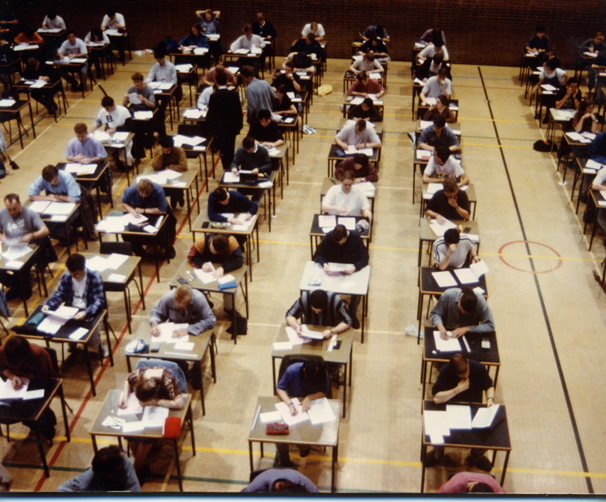
With exams around the corner, most students' minds turn to the process of studying. Do you know your particular method for assimilating information? Do you know what works best for you? Here are a few general tips:

  1. Get your attitude right. Positive thinking won't make you pass the test if you haven't studied, but negative thinking can make you fail even when you know the work. It's the magic of our brain, the "mind over matter" phenomenon. So tell yourself you'll do well in the exams. Tell yourself you love to study. Once you've studied hard, tell yourself you know the work.
  2. Get your health right. Make sure you get enough sleep. If you're underslept, you won't be productive. Sleep is never a waste of time - your body and brain need it.
  3. Do you know what helps you learn well? A dim room or a bright room? Morning or evening? Bullet points or understanding the overall picture? Working on one thing or many things at once? Buy a copy of LSA Adult to help you answer these questions.
  4. Some fun tools to help you study (careful though, or they can become too time consuming and counter-productive): mind maps, reading textbooks, remembering.
  5. A fellow student talks about studying here.
Good luck!


Friday, November 04, 2011

Learning Styles and Exam Preparation

Barbara Prashnig explains the importance of understanding the role of learning styles in studying and exam preparation:

"Thousands of students will soon be preparing themselves for the next round of exams in schools all over the world. Many will suffer from anxiety, frustration and despair because they know they are fighting a losing battle.

Considering learning styles in the context of information intake (learnining) and output (sitting exams), our research over the last twenty years shows that the points of difference are this:

a) During the presentation of new and/or difficult information in class, learning styles need to be accommodated to ensure understanding, longterm memory and the best possible learning.

b) When students study and prepare for exams they need to be made aware of their personal learning styles and should be allowed to learn in their own way, in the right environment, and with the most appropriate study techniques for their own style.

c) During tests and exams, learning styles are not so crucial because most students have enough flexibility to cope with adverse situations; this is especially true when the learning process preceding the exam has been accomplished with teaching methods matching their personal learning styles. When students are allowed to learn in their best way, they understand and remember better and are much more confident in showing what they know in an exam situation, even when their personal learning styles are not being matched during the exam. Yet they are less prone to failure or having memory lapses because with LS based study techniques, curriculum content is more readily available, even under pressure."

Friday, October 28, 2011

E-Course: Last Chance to Register

Here, at Creative Learning, we are dedicated to the subject of learning. This means learning in all its forms and in every environment; from formal settings to home study to the workplace. Our speciality is HOW we learn, before WHAT we learn. If you'd like to learn more about Style Analysis (the HOW of learning), here's an opportunity for you: we are offering an online course during the first ten days of November 2011. Please email info@clc.co.nz to register. Teachers, parents, students - all welcome.

Friday, October 21, 2011

Reminder: Our Learning Style E-Course in November

Have you ever wondered what it implies for a child’s learning when they are highly holistic or internally motivated? Or looked at a group profile of your class and compared it to your own Teaching Style Analysis report?


Now is the time to dig deeper into the concept of Learning Styles.

When: 1 - 10 November 2011

Where: online

How much: USD149.00


Click here for more information.

Wednesday, October 12, 2011

The Secret of Personal Learning Style Differences

Our popular online course (Introduction to LSA) is back!
When: 1 - 10 November 2011
Where: online
How much: USD149.00
We don’t have set times when you have to be in front of the computer - do it at your own leisure. Nor do we have Real Time participation, though email participation is encouraged. 
Classes will be held on a designated Yahoo Group. The way it'll work will be fairly structured yet informal, to accommodate all learning styles and most schedules:
  • the tutor will post a lesson on the forum (this will be available on the yahoo group's website and as an email sent to your address), usually with homework assignments
  • the participants will ask questions, post feedback and share homework - all by means of an email/post to the yahoo group
  • although the lessons will be posted on designated dates, the participants will be free to do them whenever it's convenient, bearing in mind that it's always best to do it when most of the class is doing it, of course....
Click here for more information.